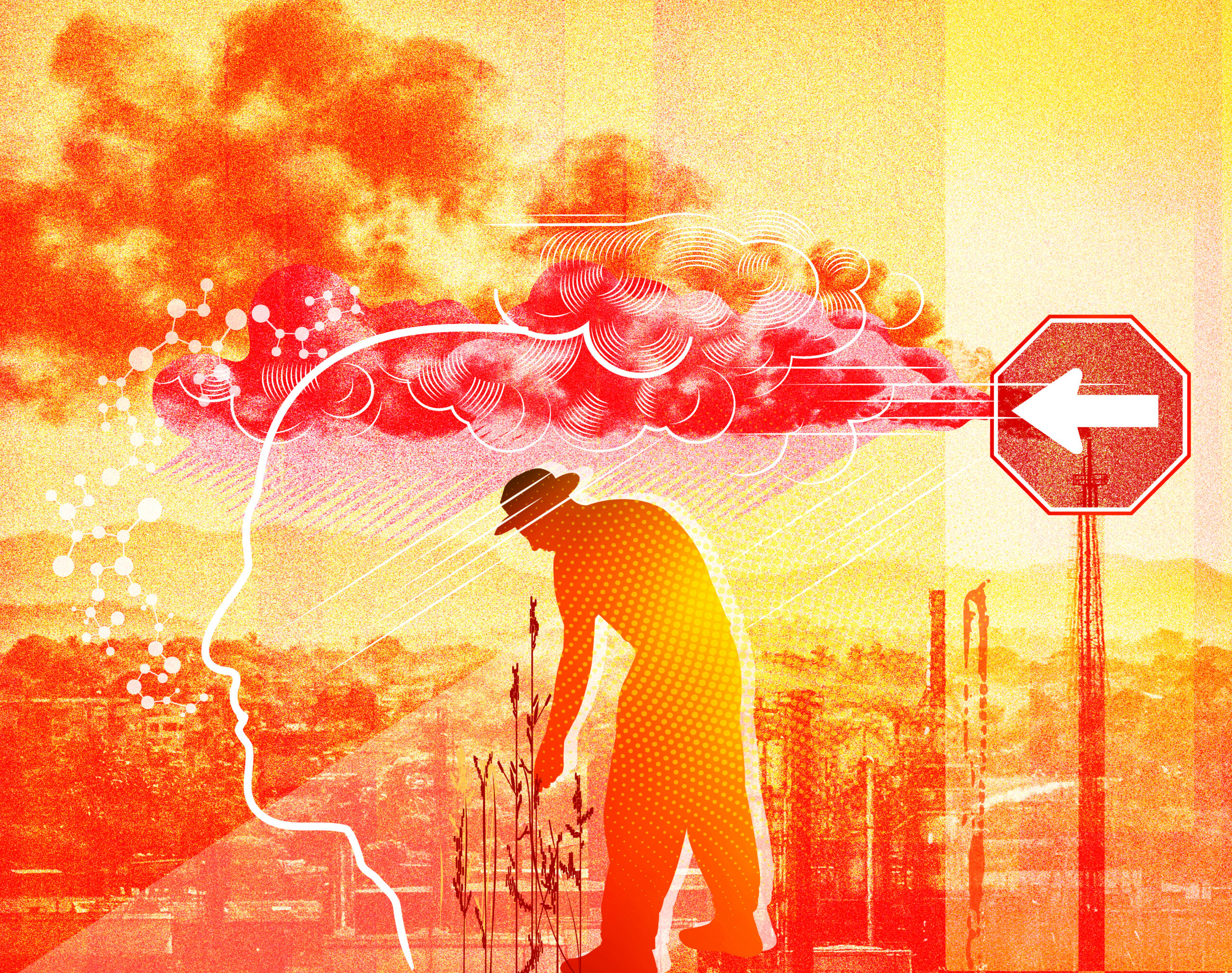
 Why do we care about air pollution? The aesthetic costs of vistas obliterated by smoggy air are obvious. And, as I have earlier reported in this column (March 2004, Winter 2006), there is growing evidence that air pollution can have adverse health effects, including increased morbidity and higher death rates. Recent research by Joshua Graff-Zivin and Matthew Neidell (2012) shows that air pollution has additional costs in the form of reduced worker productivity.
Ground-level ozone is a nationally important air pollutant formed by interactions between nitrogen oxide (NOx) and volatile organic chemicals (VOC) in the presence of heat and sunlight. Ozone irritates lung airways, decreases lung function, and increases respiratory symptoms such as coughing and difficulty in breathing. This can aggravate asthma and cause bronchitis and pneumonia. The Environmental Protection Agency (EPA) has established a national standard for ozone, specifying that ambient levels not exceed 75 parts per billion (ppb). The agency is considering a tightening of this standard; many commentators believe that the permissible level will be cut by about 10 ppb.
Graff-Zivin and Neidell examine the impact of ozone on agricultural productivity and find that even in circumstances in which the national air quality standard is generally met, higher ozone levels reduce worker output by economically important amounts. Indeed, according to the authors’ estimates, the productivity of agricultural workers could be raised by about 5.5 percent if their average ozone exposure was cut by 10 ppb. Translated to a national scope, this suggests that a 10 ppb reduction in permissible ozone levels would raise agricultural productivity by about $700 million.
In the developing world, where incomes depend heavily on agriculture, ozone likely has much larger adverse effects on economies and human well-being. Nearly 1.1 billion individuals—35 percent of the labor force—work in the agricultural sector worldwide. The effects of ozone may be especially large in countries such as India, China, and Mexico, where rapid industrial growth and automobile penetration help produce large emissions of NOx and VOCs, yielding substantially higher levels of ozone pollution.
The explicit focus of Graff-Zivin and Neidell is solely on the impact of ozone on agricultural productivity, but the paper is noteworthy for the quality of the data and for the authors’ meticulous attention to details. They utilize daily data on the measured output of individual workers who are paid strictly on the basis of the amount of each crop they harvest. Environmental factors, such as ozone concentrations, are observed on a daily basis at nearby reporting stations, and the authors control for other important factors that affect worker productivity, such as ambient temperature, sunlight, humidity, and precipitation. They also go to exhaustive lengths to ensure that no other confounding factors might contaminate their findings. The EPA has been known to promulgate regulations based on evidence and assumptions that might charitably be described as “weak.” As the agency considers a revision of the ozone standard, it is work of the caliber of Graff-Zivin and Neidell that should be relied upon.
Even so, there is a cautionary tale here when it comes to the regulation of ozone. The EPA has extensive rules governing the permissible formulation of gasoline in the United States. The chief objective of these regulations is to lower ozone concentrations by cutting volatile organic compounds, an important ozone precursor. These regulations are estimated to cost about $1.5 billion to $2 billion every year in the United States. The rules also have contributed to periodic localized shortages of gasoline, because they inhibit transshipments of gasoline across many areas of the country. Despite these high costs, recent research by Auffhammer and Kellogg (2011) finds that the EPA’s gasoline content regulations have failed to produce any measurable reduction in ground-level concentrations of ozone in the United States.
The moral of this story is twofold. First, sensible environmental regulations can only be achieved if the EPA relies on research of the quality discussed here. Second, as Auffhammer and Kellogg make clear, this is not enough, for the EPA’s gasoline formulation standards have failed to produce what is ostensibly their objective: lower ozone concentrations. This raises the very real specter that the EPA’s next round of ozone regulations may once again produce high costs with little to show in benefits.
References
Graff-Zivin, Joshua, and Matthew Neidell. 2012. The Impact of Pollution on Worker Productivity. American Economic Review 102(7): 3652–73.
Auffhammer, Maximillian, and Ryan Kellogg. 2011. Clearing the Air? The Effects of Gasoline Content Regulation on Air Quality. American Economic Review 101(6): 2687–722.