Summary

With abundant rainfall, the southeastern United States has rarely experienced conflicts over the allocation of water. But that is changing. As population grows, the demand for water grows, and when periodic drought occurs, disputes can result.
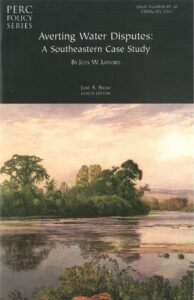
In "Averting Water Disputes: A Southeastern Case Study," Jody Lipford analyzes problems in the Apalachicola-Chattahoochee-Flint river basin, which covers parts of Georgia, Alabama, and Florida. Lipford shows how political decisions have created turmoil and indecision, and argues that markets for water can avert crises and resolve problems peacefully.
PERC, the Property and Environment Research Center, in Bozeman, Montana, is a non-profit institute dedicated to improving environmental quality through markets. PERC Policy Series papers apply PERC's knowledge of property rights and markets to timely issues.
Jody Lipford is associate professor of economics at Presbyterian College in Clinton, South Carolina. He received his bachelor's degree in economics from Francis Marion College and his master's and Ph.D. degrees from Clemson University. Lipford wrote this essay while he served as a visiting scholar with PERC. A previous paper, "Jocassee Gorges - Private Vice or Public Virtue?" by Lipford, Jerry Slice, and Bruce Yandle was published by PERC in 2002 as a research study.

Founded 30 years ago in Bozeman, Montana, PERC—the Property and Environment Research Center—is the nation’s oldest and largest institute dedicated to improving environmental quality through property rights and markets.
PERC’s publications, each designed to resonate with specific groups, move ideas generated at PERC to broader audiences.
Research is at the heart of PERC's work, with a focus on the question: What is the link between economic growth and environmental quality?
The goal of PERC’s programs is to fully realize the vision of establishing “PERC University,” where scholars, students, policy makers, and others convene to expand the applications of free market environmentalism.
PERC's fellowships share a common goal of exposing new scholars, students, journalists, and policy makers to free market environmentalism, as well as enable scholars already familiar with FME to explore new applications.
PERC continues to publish and present a broad range of research and discussion through podcasts, videos, and other multimedia channels.