 DOWNLOAD THE FULL REPORT
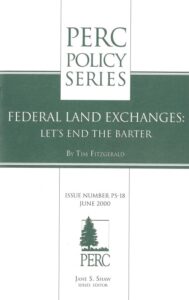
It’s time to let federal agencies buy and sell land, says Tim Fitzgerald in a new PERC Policy Series paper. “Federal Land Exchanges: Let’s End the Barter” offers a practical way to reform the costly and time-wasting federal land exchange process. At present, agencies such as the Forest Service and the Bureau of Land Management are prohibited from buying and selling land to create more manageable blocks of land.
Land exchanges have evolved as a way of reconfiguring scattered land holdings, especially in the West. Sometimes public land is checkerboarded with private land; in other places, federal land is so remote and far-flung that access is virtually impossible.
Land exchanges address the problem but they are cumbersome and time-consuming and frequently criticized for not being fair. Many useful trades are never completed. “Allowing the direct sale and purchase of land with revenues retained in a trust fund will give managers the flexibility they need to make better management decisions,” says Fitzgerald.
Fitzgerald notes that Congress has recognized the problem, and a bill under consideration in the Senate (S.1892) would take some steps to encourage buying and selling of federal land. While it does not go far enough, it is a good first step.
The author is a former research assistant with PERC who currently makes his living as a guide and outfitter in Colorado. Copies of the paper (PS-18) are available from PERC as well as on this web site.
Download the full report, including endnotes and references.