Summary
Malthus will always be associated with the idea of a social and economic trap, in which population grows faster than food production. But Malthus did not believe in a population apocalypse, as many of his followers do today. He argued that basic institutions such as property rights, marriage, and free markets would restrain excessive population and encourage economic growth.
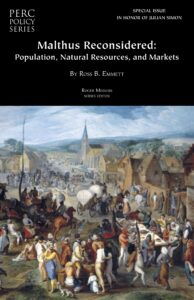
This essay, “Malthus Reconsidered: Population, Natural Resources, and Markets,” will end the misunderstanding Malthus suffers from his supporters and his critics. The author, Ross B. Emmett, wrote this essay while a Julian Simon Fellow at PERC in 2005. Julian Simon Fellows explore environmental problems in the tradition of Julian Simon, whose studies challenged conventional wisdom, especially in natural resource and population issues. Simon’s views have been increasingly accepted over time. This essay is part of the PERC Policy Series of papers on timely environmental topics.
Ross B. Emmett is associate professor of political theory and constitutional democracy at Michigan State University. His teaching focuses on the political economy of constitutional democracies. His research concerns economic thought and the history of economics at the University of Chicago between the 1920s and the 19802. He is co-director of the Michigan Center for Innovation and Economic Prosperity and an editor of the research annual, Research in the History of Economic Thought and Methodology.

Founded 30 years ago in Bozeman, Montana, PERC—the Property and Environment Research Center—is the nation’s oldest and largest institute dedicated to improving environmental quality through property rights and markets.
PERC’s publications, each designed to resonate with specific groups, move ideas generated at PERC to broader audiences.
Research is at the heart of PERC's work, with a focus on the question: What is the link between economic growth and environmental quality?
The goal of PERC’s programs is to fully realize the vision of establishing “PERC University,” where scholars, students, policy makers, and others convene to expand the applications of free market environmentalism.
PERC's fellowships share a common goal of exposing new scholars, students, journalists, and policy makers to free market environmentalism, as well as enable scholars already familiar with FME to explore new applications.
PERC continues to publish and present a broad range of research and discussion through podcasts, videos, and other multimedia channels.