By Kendra Okonski
Summary
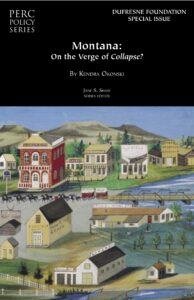
In his latest book, Collapse: How Societies Succeed or Fail, Pulitzer Prize-winning author Jared Diamond attempts to explain how a number of small, isolated societies, from Easter Island to Greenland, destroyed their environments and disappeared. A chapter of the book is devoted to a modern-day "microcosm" illustrating many of these problems: the state of Montana. Diamond says that the state's environmental problems "include almost all of the dozen types of problems that have undermined pre-industrial societies in the past, or that now threaten societies elsewhere in the world as well."
Kendra Okonski, a native of Montana who now lives in England, doesn't accept Diamond's treatment of Montana. In this essay, "Montana: On the Verge of Collapse?" she argues that Diamond has misread Montana's history and misunderstands its environmental conditions and their causes. Her essay is published as part of a series sponsored by the DuFresne Foundation and the M.J. Murdock Charitable Trust. The goal of the series is to examine ways to reconcile the changing demands for use of the West's natural resources. Okonski's essay is adapted from an article published in the journal Energy & Environment.
Since 2001, Okonski has been the environment program director for the International Policy Network, an institute based in London. She is editor or coeditor of several books, including Environment and Health (2004) and Adapt or Die (2003), and is a fellow of the Royal Society for the Arts. Previously, Okonski worked as a researcher at the Competitive Enterprise Institute in Washington, DC. She has a degree in economics from Hillsdale College.

Founded 30 years ago in Bozeman, Montana, PERC—the Property and Environment Research Center—is the nation’s oldest and largest institute dedicated to improving environmental quality through property rights and markets.
PERC’s publications, each designed to resonate with specific groups, move ideas generated at PERC to broader audiences.
Research is at the heart of PERC's work, with a focus on the question: What is the link between economic growth and environmental quality?
The goal of PERC’s programs is to fully realize the vision of establishing “PERC University,” where scholars, students, policy makers, and others convene to expand the applications of free market environmentalism.
PERC's fellowships share a common goal of exposing new scholars, students, journalists, and policy makers to free market environmentalism, as well as enable scholars already familiar with FME to explore new applications.
PERC continues to publish and present a broad range of research and discussion through podcasts, videos, and other multimedia channels.