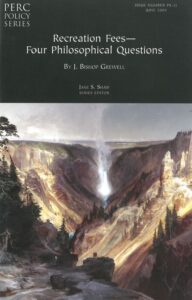
Recreation Fees --
Four Philosophical Questions
By J. Bishop Grewell
Full Text PDF
About the Author
Summary
Beginning in 1996, the federal government started raising (and in some cases newly instituting) recreation fees on public lands and using them at the sites where they were collected. This Fee Demonstration Program, which is scheduled to end in 2004, has sparked a debate over ethical and practical issues.
For example, do such fees keep low-income people from enjoying national parks and forests? Are fees "double taxation"? Are they commercializing our national parks? The answers are not easy or obvious. Distilling these concerns into four specific questions, J. Bishop Grewell thoughtfully addresses them in this essay, "Recreation Fees -- Four Philosophical Questions
The essay is part of the PERC Policy Series , which applies PERC's knowledge of property rights and markets to timely issues. PERC, the Property and Environment Research Center, in Bozeman, Montana, is a non-profit institute dedicated to improving environmental quality through markets.
J. Bishop Grewell, a PERC research associate, is currently studying law at Northwestern University Law School. He has a master's degree in environmental management from the Yale School of Forestry and Environmental Studies and a bachelor's degree from Stanford. Grewell has published many articles and is co-author with Clay Landry of Ecological Agrarian: Agriculture's First Evolution in 10,000 Years (Purdue University Press).

Founded 30 years ago in Bozeman, Montana, PERC—the Property and Environment Research Center—is the nation’s oldest and largest institute dedicated to improving environmental quality through property rights and markets.
PERC’s publications, each designed to resonate with specific groups, move ideas generated at PERC to broader audiences.
Research is at the heart of PERC's work, with a focus on the question: What is the link between economic growth and environmental quality?
The goal of PERC’s programs is to fully realize the vision of establishing “PERC University,” where scholars, students, policy makers, and others convene to expand the applications of free market environmentalism.
PERC's fellowships share a common goal of exposing new scholars, students, journalists, and policy makers to free market environmentalism, as well as enable scholars already familiar with FME to explore new applications.
PERC continues to publish and present a broad range of research and discussion through podcasts, videos, and other multimedia channels.