
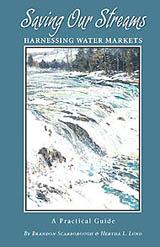
August 2007
By Brandon Scarborough and Hertha Lund
Bound copies of the report are available atPERC for $10 - email perc@perc.org.
A Summary
Declining stream flows throughout the West are threatening critical fish and other wildlife populations, recreational opportunities, and the health and aesthetic beauty of riparian ecosystems. As populations continue to grow, so too does the need to remove water from streams to meet urban needs. The dilemma is how to protect instream flows and still meet growing demand for out-of-stream uses that are helping to enrich local economies.
The solution: water markets. Federal and state agencies and conservation groups dedicated to restoring stream flows are increasingly turning to markets to connect willing buyers and sellers of water rights. Throughout much of the West, water rights are tradable and can be bought, leased, or donated for environmental purposes.
This handbook is a guide for policymakers, environmentalists, farmers and ranchers, agency officials, and others who are passionate about restoring instream flows through voluntary markets. Between 1998 and 2005, markets have grown significantly in many western states; while in others, political, legal and even social barriers have inhibited their development. This booklet details the following:
| • A comprehensive look at the state of water markets • The legal foundation of water rights & laws that influence markets • State–by–state survey of legislation and market activity • State–by–state survey of legislation and market activity • Advice for willing buyers and sellers • Market participants and fair market values for instream flows • Market participants and fair market values for instream flows |

Brandon Scarborough is a research fellow at PERC in Bozeman, Montana, with a background in biology and markets for environmental quality.
Hertha L. Lund practices law at the Wittich Law Firm in Bozeman, Montana, where she represents landowners and water rights holders in transactions and litigation. Lund has been involved in numerous, completed water policy and litigation issues in the state of Washington and in other western states.


Founded 30 years ago in Bozeman, Montana, PERC—the Property and Environment Research Center—is the nation’s oldest and largest institute dedicated to improving environmental quality through property rights and markets.
PERC’s publications, each designed to resonate with specific groups, move ideas generated at PERC to broader audiences.
Research is at the heart of PERC's work, with a focus on the question: What is the link between economic growth and environmental quality?
The goal of PERC’s programs is to fully realize the vision of establishing “PERC University,” where scholars, students, policy makers, and others convene to expand the applications of free market environmentalism.
PERC's fellowships share a common goal of exposing new scholars, students, journalists, and policy makers to free market environmentalism, as well as enable scholars already familiar with FME to explore new applications.
PERC continues to publish and present a broad range of research and discussion through podcasts, videos, and other multimedia channels.