Summary
Irrespective of the uncertainties surrounding the causes of climate change, the United States is poised to join the rest of the developed world in a fight against rising carbon dioxide levels.
Recently introduced legislation is proposing national limits on greenhouse gas emissions—CO2 in particular—while adopting provisions that would give affected companies some flexibility in how emission reduction goals are met. One employable strategy is to grow trees, which naturally remove CO2 from the air during photosynthesis; in essence, offsetting emissions from power plants, industrial facilities, and even cars. Carbon stored—sequestered—in trees would generate tradable credits which affected parties could buy and sell to help meet their respective emission reduction targets.
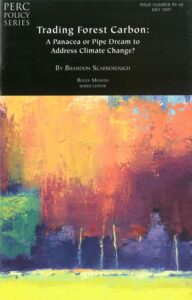
In “Trading Forest Carbon: A Panacea or Pipe Dream to Address Climate Change” PERC research fellow Brandon Scarborough takes a detailed look at the efficacy of employing forests and markets for sequestered carbon in the United States to address rising CO2 levels. This publication provides a thorough explanation of the forest carbon cycle and the mechanics of emission markets, while exposing many of the often overlooked pitfalls of commodifying forest carbon.
Brandon Scarborough is a research fellow at PERC currently focused on the use of water markets in the West to restore stream flows for wildlife, fish and other environmental amenities. His other interests include the interactions between natural resources and institutional quality, climate change, and how economic prosperity affects individuals’ demands for environmental quality. A native of North Carolina, Scarborough earned bachelor’s degrees in business and biology at Appalachian State University and a master’s degree in applied economics from Montana State University.


Founded 30 years ago in Bozeman, Montana, PERC—the Property and Environment Research Center—is the nation’s oldest and largest institute dedicated to improving environmental quality through property rights and markets.
PERC’s publications, each designed to resonate with specific groups, move ideas generated at PERC to broader audiences.
Research is at the heart of PERC's work, with a focus on the question: What is the link between economic growth and environmental quality?
The goal of PERC’s programs is to fully realize the vision of establishing “PERC University,” where scholars, students, policy makers, and others convene to expand the applications of free market environmentalism.
PERC's fellowships share a common goal of exposing new scholars, students, journalists, and policy makers to free market environmentalism, as well as enable scholars already familiar with FME to explore new applications.
PERC continues to publish and present a broad range of research and discussion through podcasts, videos, and other multimedia channels.