Water shortages are a growing problem worldwide. But global warming and increased population are not the cause. Instead, government subsidies have caused unbridled demand for cheap water, and restrictions on uses of water have limited the available supply. Government attempts to curb demand and increase supplies by building dams and desalination plants have only made matters worse.
In 1902, the federal government launched a massive dam-building program designed to make the desert "bloom as a rose" and advance settlement of the West. These federal reclamation projects were successful on both counts, but the cheap water provided by the projects caused environmental problems. For example, the massive dams harnessing the Columbia River disrupted salmon migration, while in other areas, excessive irrigation led to leaching of harmful chemicals and elements from the soil into rivers, lakes and wetlands.
In addition, state governments have imposed limits on water transfers. The result has been to hold water captive in historic uses such as flood irrigation, while the demand for water to meet urban needs and protect environmental amenities continues to grow.
In the early 1980s, PERC was a pioneer in promoting the use of markets to encourage water conservation and to reallocate water to higher valued uses. The idea has caught on. States have begun to remove obstacles to water trading, and markets are on the rise. In 1991, after several years of drought, California instituted a water bank to allow temporary water transfers from farms to thirsty cities. In 1995, Montana passed legislation allowing anyone to lease water rights to maintain instream flows for fish. Arizona is looking for ways to market its unused share of Colorado River water to California and Nevada.
Water is a commodity like any other; however, it is often perceived as unique. This perception has led to political interference and has disrupted water trading. Fortunately, policy makers are beginning to realize that water crises need not occur if individuals are allowed to respond to scarcity through market processes.
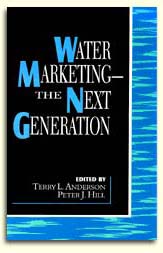
For more information from PERC associates on water policy, see Water Marketing The Next Generation, edited by Terry L. Anderson and Peter J. Hill (Rowman and Littlefield, 1997).Water Markets: Priming the Invisible Pump by Terry L. Anderson and Pamela S. Snyder (Cato, 1997) and PERC Policy Series PS-9 deal with the same topic. PERC Research Associate Clay J. Landry has written a practical guide, Saving Our Streams Through Water Markets (PERC 1998).

Founded 30 years ago in Bozeman, Montana, PERC—the Property and Environment Research Center—is the nation’s oldest and largest institute dedicated to improving environmental quality through property rights and markets.
PERC’s publications, each designed to resonate with specific groups, move ideas generated at PERC to broader audiences.
Research is at the heart of PERC's work, with a focus on the question: What is the link between economic growth and environmental quality?
The goal of PERC’s programs is to fully realize the vision of establishing “PERC University,” where scholars, students, policy makers, and others convene to expand the applications of free market environmentalism.
PERC's fellowships share a common goal of exposing new scholars, students, journalists, and policy makers to free market environmentalism, as well as enable scholars already familiar with FME to explore new applications.
PERC continues to publish and present a broad range of research and discussion through podcasts, videos, and other multimedia channels.