Summary
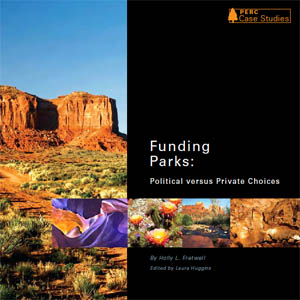
Some state park systems rely on tax dollars provided through state general funds. When state budgets are tight, park funding is a lower priority than projects such as schools and hospitals. Hence park budgets are quick to hit the chopping block, leading to threats of park closures or reduced services.
Rather than ride the roller coaster of state budgets, some parks have leased their operational activities to private managers. These private entities have proven they can operate the parks more efficiently, and sites that were once a drain on agency funds are now generating revenue.
Private management can provide consistent, quality stewardship as well as more customer service.
Founded 30 years ago in Bozeman, Montana, PERC—the Property and Environment Research Center—is the nation’s oldest and largest institute dedicated to improving environmental quality through property rights and markets.
PERC’s publications, each designed to resonate with specific groups, move ideas generated at PERC to broader audiences.
Research is at the heart of PERC's work, with a focus on the question: What is the link between economic growth and environmental quality?
The goal of PERC’s programs is to fully realize the vision of establishing “PERC University,” where scholars, students, policy makers, and others convene to expand the applications of free market environmentalism.
PERC's fellowships share a common goal of exposing new scholars, students, journalists, and policy makers to free market environmentalism, as well as enable scholars already familiar with FME to explore new applications.
PERC continues to publish and present a broad range of research and discussion through podcasts, videos, and other multimedia channels.