Introduction
Wildfires have emerged as one of the most pressing environmental challenges of the 21st century, with far-reaching economic and ecological consequences.1Andrew Sullivan, Elaine Baker, Tiina Kurvits, Alexandra Popescu, Alison K Paulson, Amy Cardinal Christianson, Ayesha Tulloch, Bibiana Bilbao, Camilla Mathison, Catherine Robinson, et al. Spreading Like Wildfire: The Rising Threat of Extraordinary Landscape Fires. 2022. In the United States alone, total annual wildfire-related damages are estimated at $394 to $893 billion, equivalent to 2 to 4 percent of GDP.2Joint Economic Committee Democrats JEC. Climate-Exacerbated Wildfires Cost the U.S. Between $394 to $893 Billion Each Year in Economic Costs and Damages. Technical report, Joint Economic Committee Democrats, 2023. These costs include property loss, firefighting expenses, health impacts from smoke exposure, and disruptions to local economies and ecosystems.3Yuhan Wang and David J. Lewis. Wildfires and Climate Change Have Lowered the Economic Value of Western U.S. Forests by Altering Risk Expectations. Journal of Environmental Economics and Management, 123:102894, January 2024. ISSN 0095-0696. doi: 10.1016/j.jeem.2023.102894; Patrick Baylis and Judson Boomhower. The Economic Incidence of Wildfire Suppression in the United States. American Economic Journal: Applied Economics, 15(1):442–73, 2023. doi: 10.1257/app.20200662; David Molitor, Jamie T. Mullins, and Corey White. Air Pollution and Suicide in Rural and Urban America: Evidence from Wildfire Smoke. Proceedings of the National Academy of Sciences, 120(38): e2221621120, September 2023. doi: 10.1073/pnas.2221621120; Sam Heft-Neal, Carlos F. Gould, Marissa L. Childs, Mathew V. Kiang, Kari C. Nadeau, Mark Duggan, Eran Bendavid, and Marshall Burke. Emergency Department Visits Respond Nonlinearly to Wildfire Smoke. Proceedings of the National Academy of Sciences, 120(39):e2302409120, September 2023. doi: 10.1073/pnas.2302409120; Mark Borgschulte, David Molitor, and Eric Yongchen Zou. Air Pollution and the Labor Market: Evidence from Wildfire Smoke. Review of Economics and Statistics, 106(6):1558–1575, 2024; V. Kerry Smith. Nonmarket Valuation of Environmental Resources: An Interpretive Appraisal. Land Economics, 69(1):1–26, 1993. ISSN 00237639. doi: 10.2307/3146275. Recent estimates suggest that health damages from wildfire-induced exposure to fine particulate matter (PM2.5) alone may exceed all other climate-related risks in the United States.4Minghao Qiu, Jessica Li, Carlos F. Gould, Renzhi Jing, Makoto Kelp, Marissa L. Childs, Jeff Wen, Yuanyu Xie, Meiyun Lin, Mathew V. Kiang, Sam Heft-Neal, Noah S. Diffenbaugh, and Marshall Burke. Wildfire Smoke Exposure and Mortality Burden in the USA Under Climate Change. Nature, September 2025. ISSN 1476-4687. doi: 10.1038/s41586-025-09611-w. Looking ahead, wildfire risk is expected to intensify with continued climate change, more development in the wildland-urban interface, and the long-term legacy of fire suppression.5John T. Abatzoglou and A. Park Williams. Impact of Anthropogenic Climate Change on Wildfire Across Western US Forests. Proceedings of the National Academy of Sciences, 113(42):11770–11775, October 2016. doi: 10.1073/pnas.1607171113. doi: 10.1073/pnas.1607171113; Volker C. Radeloff, David P. Helmers, H. Anu Kramer, Miranda H. Mockrin, Patricia M. Alexandre, Avi Bar-Massada, Van Butsic, Todd J. Hawbaker, Sebastián Martinuzzi, Alexandra D. Syphard, and Susan I. Stewart. Rapid Growth of the US Wildland-Urban Interface Raises Wildfire Risk. Proceedings of the National Academy of Sciences, 115(13):3314–3319, March 2018. doi: 10.1073/pnas.1718850115; Tania Schoennagel, Jennifer K. Balch, Hannah Brenkert-Smith, Philip E. Dennison, Brian J. Harvey, Meg A. Krawchuk, Nathan Mietkiewicz, Penelope Morgan, Max A. Moritz, Ray Rasker, Monica G. Turner, and Cathy Whitlock. Adapt to More Wildfire in Western North American Forests as Climate Changes. Proceedings of the National Academy of Sciences, 114(18): 4582–4590, May 2017.
The buildup of combustible material in forests—known as fuel loads—is a central driver of increasing wildfire severity in many semi-arid and pine-dominated systems in the western U.S.6J. D. Miller, H. D. Safford, M. Crimmins, and A. E. Thode. Quantitative Evidence for Increasing Forest Fire Severity in the Sierra Nevada and Southern Cascade Mountains, California and Nevada, USA. Ecosystems, 12(1):16–32, February 2009. ISSN 1435-0629. doi: 10.1007/s10021-008-9201-9. Historically, frequent, low-intensity fires helped regulate these fuels. In California, for example, prior to 1800, an estimated 5 to 12 percent of the landscape burned each year, much of it through Indigenous cultural burning practices.7Scott L. Stephens, Robert E. Martin, and Nicholas E. Clinton. Prehistoric Fire Area and Emissions from California’s Forests, Woodlands, Shrublands, and Grasslands. Forest Ecology and Management, 251(3):205–216, November 2007. ISSN 0378-1127. doi: 10.1016/j.foreco.2007.06.005. However, more than a century of wildfire suppression has disrupted these natural fire cycles, allowing fuels to accumulate well beyond historical levels, threatening the functionality and resilience of western forest ecosystems.8Malcolm P. North, Ryan E. Tompkins, Alexis A. Bernal, Brandon M. Collins, Scott L. Stephens, and Robert A. York. Operational Resilience in Western US Frequent-Fire Forests. Forest Ecology and Management, 507:120004, March 2022. ISSN 0378-1127. doi: 10.1016/j.foreco.2021.120004; Susan J. Prichard, Paul F. Hessburg, R. Keala Hagmann, Nicholas A. Povak, Solomon Z. Dobrowski, Matthew D. Hurteau, Van R. Kane, Robert E. Keane, Leda N. Kobziar, Crystal A. Kolden, Malcolm North, Sean A. Parks, Hugh D. Safford, Jens T. Stevens, Larissa L. Yocom, Derek J. Churchill, Robert W. Gray, David W. Huffman, Frank K. Lake, and Pratima Khatri-Chhetri. Adapting Western North American Forests to Climate Change and Wildfires: 10 Common Questions. Ecological Applications: A Publication of the Ecological Society of America, 31 (8):e02433, December 2021. ISSN 1051-0761. doi: 10.1002/eap.2433.
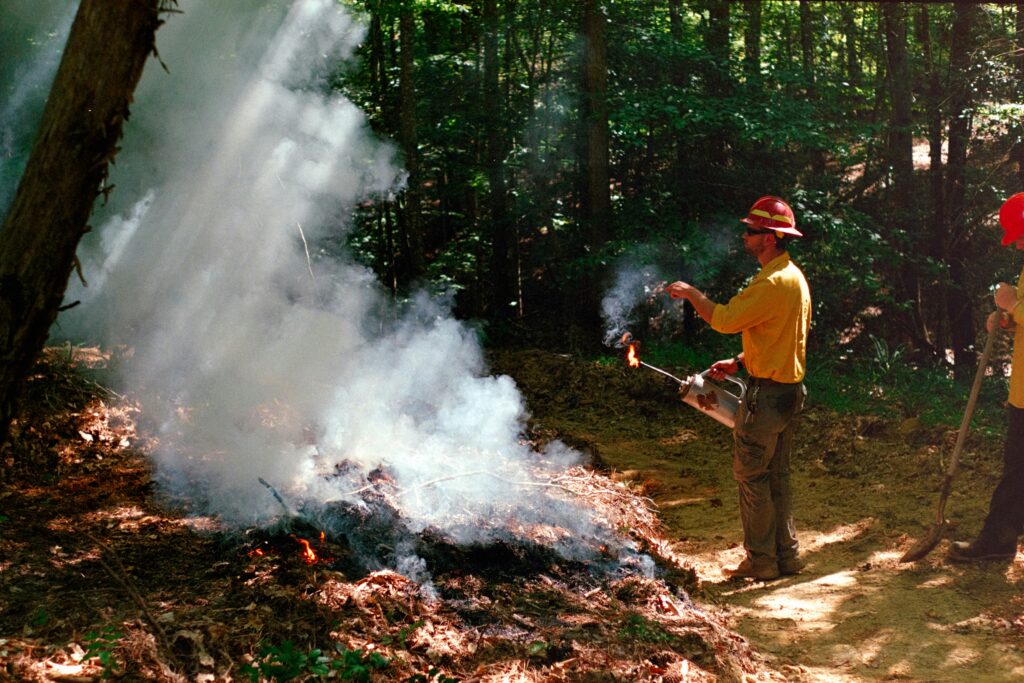
To address this growing risk, land managers increasingly rely on fuel treatments, such as prescribed burns and mechanical thinning. These practices reduce the quantity and continuity of fuels, maintain open-canopy forest structures, and remove fire-intolerant species, mimicking the role of natural fire in maintaining forest health.9James K. Agee and Carl N. Skinner. Basic Principles of Forest Fuel Reduction Treatments. Relative Risk Assessments for Decision –Making Related To Uncharacteristic Wildfire, 211(1):83–96, June 2005. ISSN 0378-1127. doi: 10.1016/j.foreco.2005.01.034. The U.S. Forest Service has pledged to treat more than 50 million acres—an area roughly the size of Utah—over the next decade through its Wildfire Crisis Strategy, marking a shift in federal wildfire policy toward more proactive risk reduction.10USFS (United States Forest Service). Wildfire Crisis Strategy Implementation Plan. Technical report, United States Forest Service, 2022.
Fuel treatments are not only ecologically effective but also economically justified.
Despite this ambitious commitment, fuel treatments remain vastly underused.11Crystal A. Kolden. We’re Not Doing Enough Prescribed Fire in the Western United States to Mitigate Wildfire Risk. Fire, 2(2), 2019. ISSN 2571-6255. doi: 10.3390/fire2020030. Public pressure and risk aversion often skew wildfire management resources toward suppression rather than prevention.12Malcolm P North, Scott L Stephens, Brandom M Collins, James K Agee, Gregory Aplet, Jerry F Franklin, and Peter Z Fulé. Reform Forest Fire Management. Science, 349(6254):1280–1281, 2015. Firefighting delivers immediate, visible results, while the benefits of fuel treatments are delayed, uncertain, and harder to observe. Budgeting dynamics reinforce this imbalance: Responding to disasters after they occur is politically easier than securing upfront prevention funding. As a result, the value of fuel treatments is frequently underappreciated, leading to persistent regulatory, fiscal, and capacity constraints that limit their implementation. These dynamics reflect a classic public-goods problem—despite broad societal benefits, there are too few incentives to invest in prevention without clear, credible evidence of their benefits.
Evaluating whether fuel treatments actually save money and reduce wildfire damages in practice has proven difficult. Reliable data and methods linking treatment locations, wildfire spread, suppression costs, and economic losses have long been limited. Most existing analyses rely on fire-simulation models or isolated case studies that are difficult to generalize, often assessing hypothetical treatment scenarios rather than real-world outcomes.13Michael H. Taylor, Andrew J. Sanchez Meador, Yeon-Su Kim, Kimberly Rollins, and Hank Will. The Economics of Ecological Restoration and Hazardous Fuel Reduction Treatments in the Ponderosa Pine Forest Ecosystem. Forest Science, 61(6):988–1008, December 2015. ISSN 0015-749X. doi: 10.5849/forsci.14-030; Molly E. Hunter and Michael H. Taylor. The Economic Value of Fuel Treatments: A Review of the Recent Literature for Fuel Treatment Planning. Forests, 13(12), 2022. ISSN 1999-4907. doi: 10.3390/f13122042; Evan E. Hjerpe, Melanie M. Colavito, Amy E.M. Waltz, and Andrew Sánchez Meador. Return on Investments in Restoration and Fuel Treatments in Frequent-Fire Forests of the American West: A Meta-Analysis. Ecological Economics, 223:108244, September 2024. ISSN 0921-8009. doi: 10.1016/j.ecolecon.2024.108244. As a result, policymakers have had little concrete evidence on whether today’s fuel treatments are cost-effective, or under what conditions they deliver the greatest benefits.
This report, produced by PERC in collaboration with UC Davis Postdoctoral Scholar Frederik Strabo and UC Davis Associate Professor Matthew Reimer, draws on two recent studies from their research that fill this critical evidence gap. Both studies examine the cost-effectiveness of fuel treatments, though each focuses on a different outcome. One study evaluates how fuel treatments influence wildfire suppression costs in the Pacific Northwest, while the other measures their impact on the economic damages from smoke emissions and property loss across the western U.S. Using newly compiled, high-resolution data on wildfire perimeters, fuel treatment locations, firefighting efforts, fire behavior, and economic damages, these studies provide the first large-scale evidence that fuel treatments are not only ecologically effective but also economically justified. All analyses presented in this report focus on fuel treatments and wildfire outcomes on U.S. Forest Service lands across the western United States. The results are expressed as the return on investment from spending one dollar on fuel treatments in terms of avoided wildfire suppression costs (Study One14Frederik Strabo and Matthew N. Reimer, “Before the Burn: The Economic Benefits of Fuel-Reduction Treatments in Wildfire-Prone Forests,” The Economic Journal, 2026, ueag037, https://doi.org/10.1093/ej/ueag037.) or avoided economic damages (Study Two15Frederik Strabo, Calvin Bryan, and Matthew Reimer, “Wildfire Damages and the Cost-Effective Role of Forest Fuel Treatments,” Science, 2026, http://www.science.org/doi/10.1126/science.aea6463.). Readers interested in detailed methods, data sources, and statistical models can refer to the papers cited for Study One and Study Two.
Research Highlights
- Fuel treatments are cost-effective. Across western U.S. Forest Service lands, treatments such as prescribed burns and mechanical thinning reduce fire suppression costs, property loss, and smoke exposure.
- In the Pacific Northwest, we find that each dollar invested in fuel treatments in national forests yields between $5 and $6 in reduced federal firefighting expenditures.
- Across the western United States, we find that each dollar invested in fuel treatments in national forests yields an average of $3.73 in expected benefits through avoided damages from smoke and property loss. Treatments avoided an estimated $2.8 billion in wildfire-related damage across western states from 2017 to 2023.
- Fuel treatments strengthen forest management and conservation efforts. By reducing suppression costs, proactive treatments free Forest Service budgets for critical restoration work—including road and trail maintenance, habitat improvement, and forest resilience projects—allowing managers to reinvest in the long-term health of national forests.
- Larger, landscape-scale projects and prescribed burns deliver greater returns. Broad, landscape-scale treatments and prescribed burns achieve the highest economic returns while being most effective at reducing wildfire spread and severity, highlighting the need to revisit regulatory constraints on project size or burn approvals, such as rules that implement the National Environmental Policy Act or the Endangered Species Act.
- Strategically focusing treatments boosts effectiveness. Treatment performance varies widely across projects. Prioritizing high-impact locations and continuous evaluation can help maximize economic and ecological benefits.
- Fuel treatments are public goods that require appropriate incentives. Many of the benefits from fuel treatments—such as reduced smoke exposure and lower suppression costs—extend well beyond the lands where they are implemented. Because of the mismatch between who pays and who benefits, innovative policies like public-private partnerships, targeted subsidies, and shared funding mechanisms are needed to align incentives and expand treatment capacity.
Results
Fuel treatments lower suppression costs and improve agency efficiency (Study One).
In the Pacific Northwest, we find that each dollar invested in fuel treatments yields between $5 and $6 in reduced federal firefighting expenditures. Because suppression costs account for a large share of the Forest Service’s annual budget, these savings can free resources for other restoration and maintenance priorities—many of which face a significant backlog, such as road upkeep, habitat restoration, and watershed protection.
Fuel treatments reduce both fire spread and severity (Study Two).
Consistent with decades of fire ecology research, we find that treated areas suffer markedly lower fire impacts.16Susan J. Prichard, Paul F. Hessburg, R. Keala Hagmann, Nicholas A. Povak, Solomon Z. Dobrowski, Matthew D. Hurteau, Van R. Kane, Robert E. Keane, Leda N. Kobziar, Crystal A. Kolden, Malcolm North, Sean A. Parks, Hugh D. Safford, Jens T. Stevens, Larissa L. Yocom, Derek J. Churchill, Robert W. Gray, David W. Huffman, Frank K. Lake, and Pratima Khatri-Chhetri. Adapting Western North American Forests to Climate Change and Wildfires: 10 Common Questions. Ecological Applications: A Publication of the Ecological Society of America, 31 (8):e02433, December 2021. ISSN 1051-0761. doi: 10.1002/eap.2433; James K. Agee and Carl N. Skinner. Basic Principles of Forest Fuel Reduction Treatments. Relative Risk Assessments for Decision –Making Related To Uncharacteristic Wildfire, 211(1):83–96, June 2005. ISSN 0378-1127. doi: 10.1016/j.foreco.2005.01.034; Elizabeth L. Kalies and Larissa L. Yocom Kent. Tamm Review: Are Fuel Treatments Effective at Achieving Ecological and Social Objectives? A Systematic Review. Forest Ecology and Management, 375:84–95, September 2016. ISSN 0378-1127. doi: 10.1016/j.foreco.2016.05.021. Between 2017 and 2023, directions of fires that encountered Forest Service fuel treatments burned 36 percent less total area and showed 26 percent lower rates of moderate-to-high severity—areas where canopy and surface vegetation were largely consumed, following Monitoring Trends in Burn Severity (MTBS) classifications. Prescribed burns and large, landscape-scale treatments—defined as greater than 2,400 acres—are the most effective at limiting fire spread and severity.
Fuel treatments also reduce economic damages from smoke and property loss (Study Two).
By limiting structure destruction, reducing CO2 emissions, and lowering PM2.5 exposure, treatments avoided an estimated $2.8 billion in wildfire-related damages between 2017 and 2023 across the western United States. On average, each dollar spent on treatment yields $3.73 in expected benefits through avoided damages from smoke and property loss.
Larger, landscape-scale projects deliver the greatest returns (Study Two).
Projects exceeding 2,400 acres are the most effective at reducing fire spread and severity and deliver the highest benefit-cost ratios for economic damages—5.59 for large projects, 3.19 for medium projects (600–2,400 acres), and 2.99 for smaller ones (75–600 acres). These results demonstrate that scaling up fuel treatments can substantially increase their economic return and ecological impact. They also reinforce ongoing policy debates advocating for the consolidation of treatment areas into fewer, larger, and more strategically located projects,17Marc Heller. Forest Service Facing Republican Ire on Tree-Thinning. POLITICO Pro (E&E News), 2024. and suggest that careful reassessment of existing environmental regulations—such as rules that implement the National Environmental Policy Act (NEPA) and the Endangered Species Act—could yield meaningful public risk-reduction benefits given their influence on project size.
Targeting and incentives matter (Study Two).
While most fuel treatment projects generate positive returns, performance varies widely. A few costly projects that deliver limited reductions in fire risk lower the overall benefit-cost ratio for avoided damages to 3.73, compared to the median benefit-cost ratio of 9.05. This variation underscores the importance of better spatial targeting, performance evaluation, and incentive alignment to maximize returns. Identifying which projects yield the highest benefits is essential for strategic, evidence-based investment—especially amid recent federal budget cuts and growing wildfire risk.
Toward Treatment
Despite a clear economic rationale for investing in fuel treatments, regulatory, capacity, and funding constraints continue to limit their implementation. The Forest Service, for instance, manages over 193 million acres of land with roughly 25,000 employees,18Malcolm North, April Brough, Jonathan Long, Brandon Collins, Phil Bowden, Don Yasuda, Jay Miller, and Neil Sugihara. Constraints on Mechanized Treatment Significantly Limit Mechanical Fuels Reduction Extent in the Sierra Nevada. Journal of Forestry, 113(1):40–48, January 2015. ISSN 0022-1201. doi: 10.5849/jof.14-058. which is fewer people than is required to operate a single major international airport, underscoring how forest management has become a chronically under-resourced public good. These challenges are compounded by institutional incentives that favor short-term fire suppression over long-term prevention, along with regulatory requirements—such as endangered species protections, federal and state air-quality standards, federally designated Wilderness areas, and review under NEPA—that can delay or prevent fuel-reduction projects, even in forests at high risk of wildfire.
Fuel treatments also have the characteristics of a public good: Many of their benefits—particularly cleaner air from reduced smoke exposure and lower suppression costs—extend far beyond the lands where they occur.19Jeff Wen, Sam Heft-Neal, Patrick Baylis, Judson Boomhower, and Marshall Burke. Quantifying Fire-Specific Smoke Exposure and Health Impacts. Proceedings of the National Academy of Sciences, 120(51):e2309325120, December 2023. doi: 10.1073/pnas.2309325120. This geographic mismatch between who pays and who benefits from treatments discourages local investment and can lead to free-riding by landowners who depend on public agencies to bear the cost of wildfire prevention and suppression.
Overcoming these barriers will require coordinated reform across several fronts. Many existing environmental regulations could be carefully reformed to better account for the costs of inaction that arise from overlooking the beneficial role of fire and disturbance in maintaining forest health. For example, environmental review processes under NEPA often emphasize the immediate costs of disturbance from treatment projects rather than the long-term costs of inaction—delaying or diminishing efforts that would reduce future wildfire risk and improve ecological outcomes over time. Similarly, air-quality permitting under the Clean Air Act and state-level clean air rules do not recognize the long-run smoke reduction benefits of prescribed burns—limiting their use even though they can improve overall air quality in the long term. Updating these frameworks would help accelerate the pace and scale of proactive management, especially for prescribed burns and large, landscape-scale treatments that deliver the highest returns. Likewise, other environmental protections—such as Wilderness designations and endangered species rules—should better recognize that many of the areas they safeguard are fire-adapted ecosystems, where delaying or restricting proactive management can, in some contexts, increase long-term ecological and economic risk.
Moreover, expanding capacity remains essential. The chronic shortage of forestry personnel and contracting resources of the Forest Service limits implementation even where funding exists. Historical examples offer guidance: New Deal–era programs such as the Civilian Conservation Corps illustrate how sustained federal investment in conservation workforce capacity can expand on-the-ground land management at scale. While we do not evaluate such programs in our work, this historical precedent highlights how institutional investment in workforce and implementation capacity could help scale up fuel treatments and realize the economic and ecological benefits documented in this report.
Finally, aligning incentives and reducing treatment costs will be critical for scaling up implementation. Public–private partnerships—such as reverse auctions in which contractors compete to deliver cost-effective treatments on public lands—can help expand capacity and improve efficiency. The Forest Service’s long-standing collaboration with private firms in timber sales offers a model for how these partnerships could be modernized to deliver fuel treatments at scale. Extending these efforts beyond federal lands through targeted subsidies and incentive programs can encourage private landowners to invest in proactive fire-risk reduction on their lands, helping align local actions with regional mitigation goals.
Together, these efforts would strengthen the institutional foundations needed to transform fuel treatments from an underprovided public good into a scalable, self-sustaining pillar of forest policy.
In sum, our findings provide compelling evidence that fuel treatments are a cost-effective strategy for reducing wildfire damages and restoring forest health. They offer a promising pathway to address one of the most pressing environmental challenges of the 21st century. Yet realizing their full potential will require more than scientific consensus—it will demand bold policy reform. Pairing thoughtful environmental policy reforms with well-designed economic incentives can help ensure that proactive forest management becomes the norm rather than the exception across the western United States.
For full analysis related to fire suppression costs in the Pacific Northwest, see: Frederik Strabo and Matthew N. Reimer, “Before the Burn: The Economic Benefits of Fuel-Reduction Treatments in Wildfire-Prone Forests,” The Economic Journal, 2026, ueag037, https://doi.org/10.1093/ej/ueag037.
For full analysis on wildfire damages in the western U.S., see: Frederik Strabo, Calvin Bryan, and Matthew Reimer, “Wildfire Damages and the Cost-Effective Role of Forest Fuel Treatments,” Science, 2026, http://www.science.org/doi/10.1126/science.aea6463.