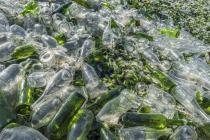
All around Montana, broken beer and wine bottles are showing up on roads and walkways. Admittedly, these are not the sharp, jagged pieces normally associated with broken glass, but rather the pulverized variety giving the glass both the consistency and appearance of gravel with the added attraction of multicolors.
A crusher turns the glass into cullet, the coarse material that resembles gravel, but can be produced without the dust or the cost of extraction. Rather than digging up the landscape, the Montana Department of Transportation (MDOT) used 900 tons of discarded glass bottles to help repave a Jefferson County highway. The first pulverizer was purchased by the state’s department of environmental quality in hopes of creating interest in the new product among local municipalities. So far, it seems to have been a wise move.
Livingston will be the first city in the state to purchase its own pulverizer. And for those that have not yet invested in the new machinery, the MDOT is still happy to help out. Helena, the state capital, is using glass cullet in several areas around the city, and Missoula has lined up some big projects, which call for pulverized glass to make concrete for sidewalks and parking lots, reports the Helena Independent Record.
While it took a small push from a state agency, the private sector is also seeing the benefits of using pulverized glass. Contractors and their customers are requesting the multicolored glass product for a variety of projects, including garden walkways.