
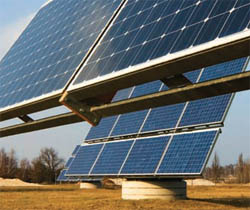
 California utility companies are investing heavily in solar power. The utilities, along with many industry experts, expect the tax breaks for solar producers will make the cost of solar energy competitive with power from coal and natural gas by 2016 when the credits expire.
Pacific Gas & Electric is investing $3 billion to build five solar power plants in the Mojave Desert. The company expects the plants to generate 900 megawatts of electricity, enough to power 540,000 California homes. The builder, BrightSource Energy, will use a technology that concentrates the sunlight from thousands of moveable mirrors in order to run a steam turbine that generates electricity. The electricity will be fed into a transmission system to serve California’s coastal cities. In some cases, costly new transmission systems may be necessary.
Southern California Edison has taken a different path to solar power. It plans to install two square miles of solar cells on warehouse roof space leased from building owners in Riverside and San Bernardino counties. The electricity from these solar cells will feed directly into neighborhood circuits without the need for a central power station. The utility intends to spend $875 million to generate 250 megawatts of electricity for 162,000 homes. According to the Environmental News Network, the solar cells will generate the same amount of electricity as a small coal-powered plant.
While the companies have chosen different paths, they all lead to a huge commitment to the future of solar energy.