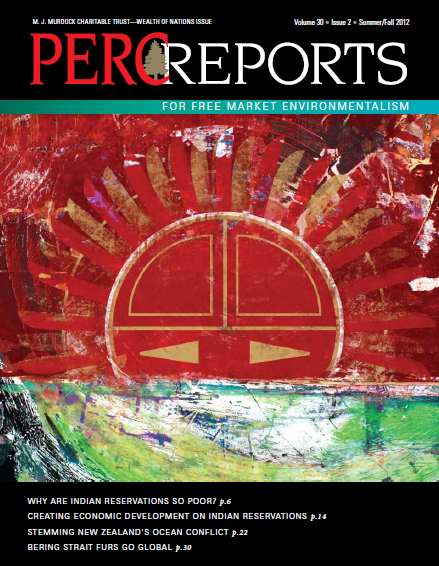
 Stories of my ancestors interacting with families of the Northwestern Shoshone tribe enthralled me as a girl. The idea that the native people were self-sufficient and often helped the early settlers survive by trading goods, such as animal skins, and by sharing their knowledge of water sources and hunting grounds was inspiring. Today, however, many “First Nations” are stuck in a welfare state. PERC’s latest issue of PERC Reports looks at past and present trends in indigenous life, shining a light on how property rights and individual initiative can help create a higher standard of living and improve environmental quality on reservations and beyond.
PERC president TERRY ANDERSON points out that American Indians and First Nations people can reach back into their rich cultural heritage and find institutions that rewarded individual initiative. The key is for tribes to take this initiative again and for Congress to give tribal nations the rights that were once theirs.
Why is it that reservations are so poor asks JOHN KOPPISCH with Forbes. People are quick to point to alcoholism or underdeveloped land, but as Koppisch wisely writes, “those are just the symptoms. Prosperity is built on property rights, and reservations often have neither.”
Tribal governments can help solve the poverty problem. ROBERT MILLER draws on his experience as Chief Justice of the Grand Ronde Tribe and as a citizen of the Eastern Shawnee Tribe to explore how native governments can establish the laws and court systems necessary to attract investment.
In the past, native nations built their economies via extensive trade networks. Arctic tribal historian, JOHN BOCKSTOCE, reveals how the Eskimos and Chukchi in the greater Bering Strait region had been trading for thousands of years before the Russian and American trading vessels arrived.
Beyond North America, IAN BOISVERT, with BlueSky Mediation & Law and a former PERC graduate fellow, introduces the idea of “Tradable Occupation Rights” for the Maori in New Zealand. Creating these rights would offer both commercial and customary ocean users a market to resolve conflict and promote more efficient uses of resources.
This special issue of PERC Reports is made possible by the generous support of the M. J. Murdock Charitable Trust. PERC is continually grateful for their investment in tribal issues and free market solutions.