
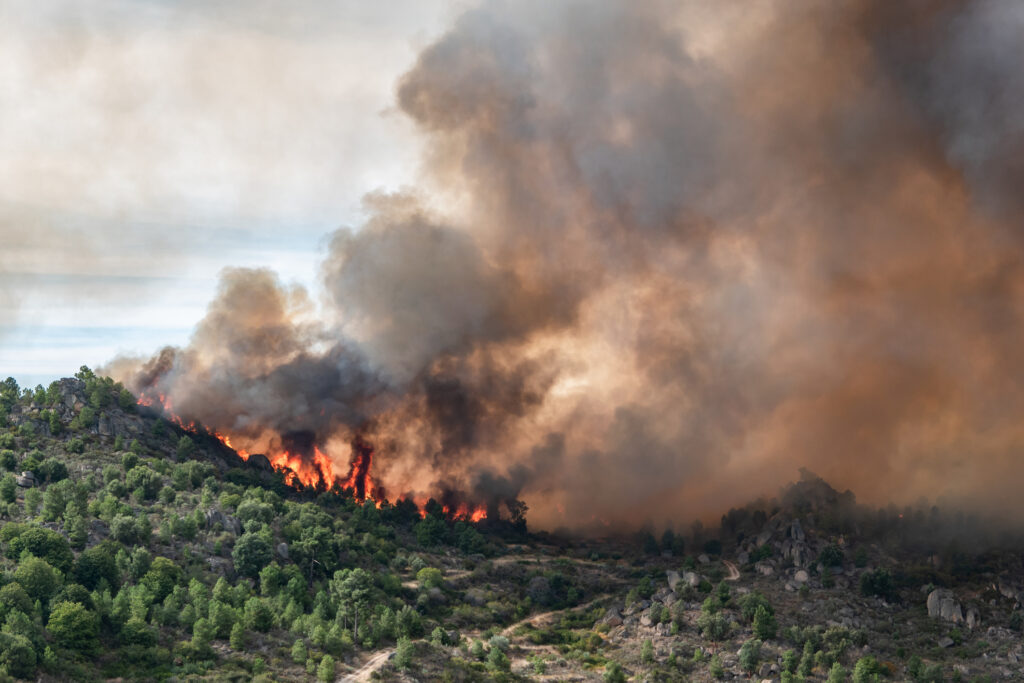
The Wildfire Emissions Prevention Act (S. 5045) has passed the Senate Environment and Public Works Committee by a unanimous vote of 19-0, marking an important step forward for legislation aimed at removing federal barriers to prescribed fire. PERC has supported this effort because it would give states a clearer, more workable path to use one of the most effective tools available for restoring forests and reducing catastrophic wildfire risk. PERC Vice President of Law and Policy Jonathan Wood testified before the committee on an earlier draft of WEPA last September, and PERC celebrates the bill’s continued progress.
The bipartisan legislation would address a core contradiction in how the Clean Air Act (CAA) regulates wildfire emissions: prescribed burns are one of the most effective tools for reducing hazardous fuels before they feed a catastrophic wildfire, but federal policy can discourage their use. Under the CAA, the Environmental Protection Agency (EPA) sets national air-quality standards, while states develop plans to meet them. But occasionally, a state’s air quality can be diminished by events outside its control. That’s why Congress also created an “exceptional events” process, which allows states to ask EPA to exclude air-quality data influenced by events outside their control—most notably catastrophic wildfires—from certain regulatory determinations.
In its attempt to avoid unfairly penalizing states for reduced air quality linked to wildfire smoke, however, Congress did not explicitly address prescribed fire in the statute’s exceptional-events definition. Prescribed fire can dramatically reduce wildfire severity, but it temporarily diminishes air quality in the process. As a result, smoke linked to prescribed burns can count against a state’s air-quality compliance, even though those burns can reduce the likelihood of much more extreme wildfire pollution in the future. Recognizing this problem, EPA has tried to accommodate prescribed fire through regulations and guidance, but doing so has produced a complicated process that states have struggled to use.
This bureaucratic inefficiency has real-world impacts, with prescribed fire remaining dramatically underused. The United States has more than one billion acres of forests and grasslands, yet the most recent national survey reported just 9.4 million acres treated with prescribed fire in 2020. Recent research also found that wildfires on lands recently treated with mechanical thinning and prescribed fire had a 32 percent lower average fire severity. And the benefits of this essential conservation tool are not limited to wildfire mitigation—prescribed fire and other active restoration can improve a forest’s ability to sequester carbon, and improve habitat for native wildlife. With an average of 6.3 million acres burned by wildfires each year over the past five years, we cannot afford for bureaucratic inefficiencies to discourage the use of essential tools like prescribed fire.⁸
The Wildfire Emissions Prevention Act would address the Clean Air Act’s misaligned incentives directly. Rather than continuing to shoehorn prescribed fire into statutory language designed around uncontrollable and nonrecurring events, WEPA would expressly recognize prescribed fire within the Clean Air Act’s exceptional-events provision. It would direct EPA to revise its regulations to reduce the burden and cost on states, clarify prescribed fire’s eligibility, and establish a process for reviewing state petitions.
At a time when millions of acres burn in wildfires each year, federal policy should not make it unnecessarily difficult to put beneficial fire on the landscape before catastrophe strikes. WEPA offers a practical fix that better aligns clean-air policy with proactive forest stewardship. PERC thanks Sens. John Curtis (R-UT), Jeff Merkley (D-OR), Shelley Moore Capito (R-WV), Alex Padilla (D-CA), John Boozman (R-AR), and Mark Kelly (D-AZ) for their work on this legislation.