Seattle—New research reveals how rising noise from commercial shipping is directly harming endangered killer whales in the Pacific Northwest and provides an innovative market solution for quieting the seas without stifling global trade.
The report, Saving Killer Whales Without Sinking Trade, is produced by The Property and Environment Research Center (PERC), the national leader in market solutions for conservation.
The new research provides some of the first empirical evidence linking growing vessel noise from commercial shipping to the decline of the Southern Resident killer whale population.
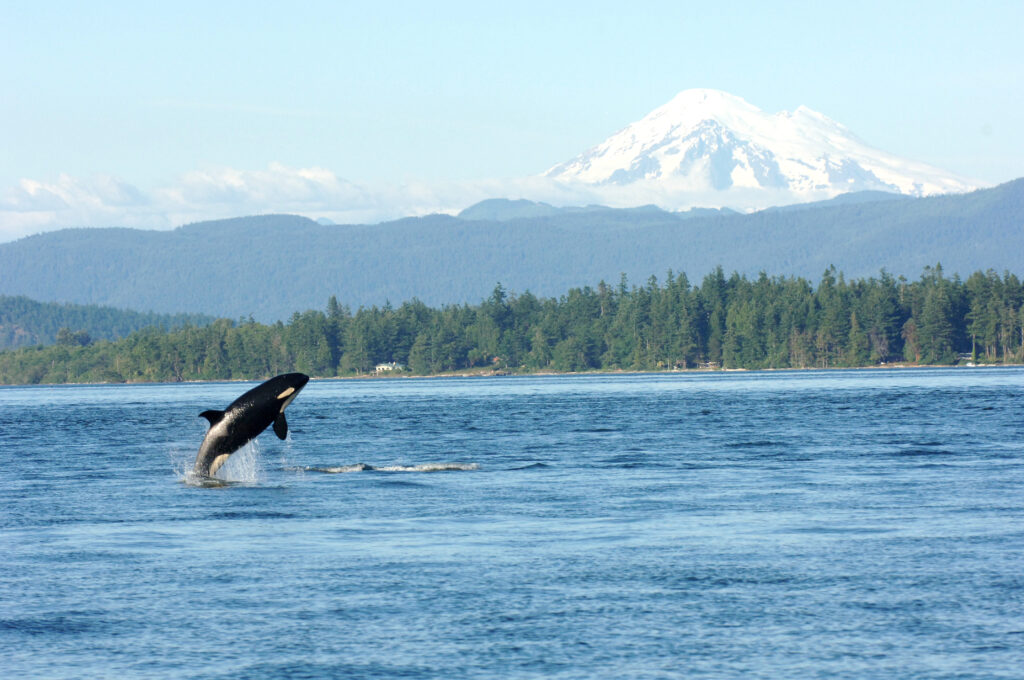
Southern Resident killer whales in Washington and British Columbia are down to just 74 animals, making them one of the most endangered marine populations in North America. Sound is critically important for the whales’ survival—they use it to navigate, hunt, and communicate. Drawing on decades of data measuring killer whales and the container shipping industry, the report finds:
- Killer whales are more than 30 percent more likely to die in noisy years compared to quiet ones.
- Female killer whales are more than 25 percent less likely to give birth following noisy years.
- Had noise levels remained at pre-2000 levels, the Southern Resident population would be 30 percent larger today.
The ports of Seattle, Tacoma, and Vancouver handle billions in goods each year, supporting jobs and communities across the Northwest as a vital thoroughfare for the international supply chain and American economy.
The report stresses that saving orcas doesn’t require shutting down trade. Instead, it proposes a market-based system of tradable noise permits—a flexible, cost-effective solution that reduces noise pollution by incentivizing innovation, promoting both whale conservation and global trade.
“Shipping noise is drowning out killer whales, but we don’t need to shut down trade to save this iconic species,” said Shawn Regan, vice president of research at PERC. “Instead, we can align incentives so conservation and commerce thrive together.”
A Smarter Alternative to Regulations
Current efforts in Washington state include voluntary slowdown programs such as the Quiet Sound campaign and new rules establishing a 1,000-yard buffer around orcas. While important, these measures are limited and often costly to industry.
A tradable permit system, by contrast, would:
- Put a clear price on vessel noise, creating incentives to reduce impacts.
- Allow companies flexibility in how they comply—whether through quieter ship technology, consolidating cargo into fewer, larger ships, or purchasing permits from others.
- Encourages long-term innovation by rewarding firms that invest in noise-reducing technologies.
- Scale over time, with gradually tightening caps that strengthen protection for whales.
PERC’s proposal demonstrates that protecting killer whales and sustaining commerce need not be at odds. Similar market-based systems have successfully conserved fisheries and reduced air pollution. Applying the same principles underwater could give these highly intelligent and beloved animals a chance to survive in the Salish Sea and beyond.