Bondurant, Wyo. – Two leading conservation organizations are joining forces to accelerate one of the most promising innovations in modern land stewardship. The Ricketts Conservation Foundation (RCF) and the Property and Environment Research Center (PERC) today announced the $600,000 Yellowstone Ecosystem Virtual Fence Collaborative, a bold effort to deploy GPS-collar livestock management technology across working ranches throughout the Yellowstone Ecosystem.
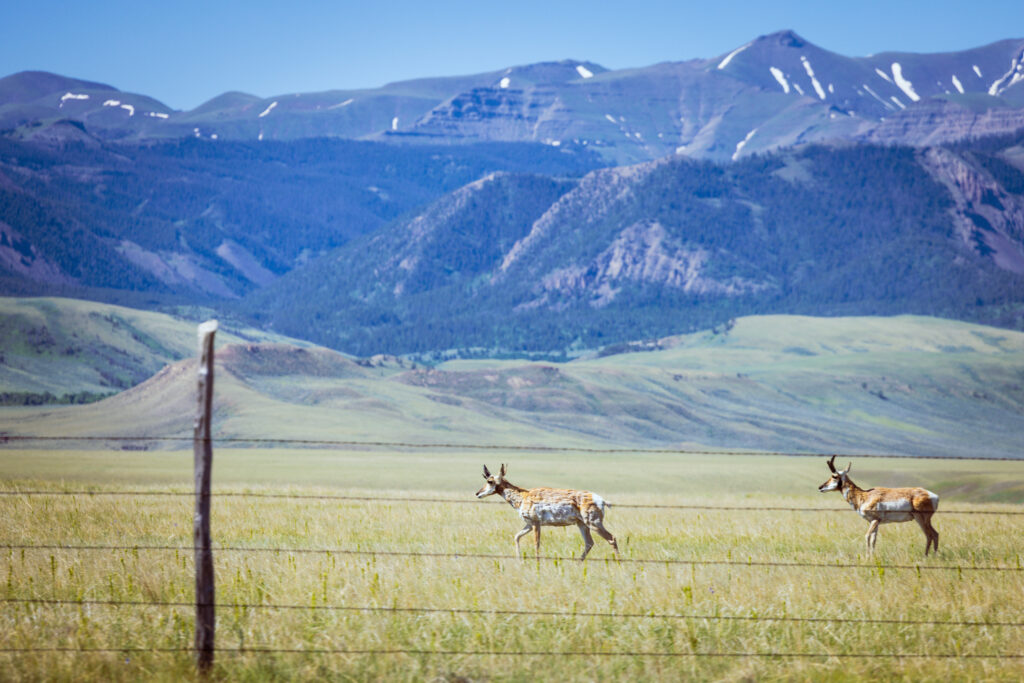
Virtual fencing is an emerging technology that replaces miles of traditional fencing, commonly barbed wire, with GPS-enabled collars that guide livestock using audio and mild physical stimulus cues. Managed from a smartphone or laptop, ranchers can create and adjust grazing boundaries almost instantaneously, improving flexibility and adaptability, and reducing infrastructure costs. The technology allows ranchers to remove physical barriers from the landscape, helping wildlife migration. With it, ranchers can also keep cattle out of ecologically sensitive areas and producers can respond quickly to livestock losses, reducing conflict while supporting working ranches.
Located amidst one of the largest and most intact ecosystems in North America, the new initiative will support eight ranches that collectively span more than 366,000 acres with over 5,300 head of cattle across Wyoming and Idaho.
“The Yellowstone region is home to remarkable wildlife and working lands that support both local communities and global biodiversity,” said Shari Meeks, project manager with the Ricketts Conservation Foundation. “Partnering with livestock producers who are willing to try innovative approaches like virtual fencing is a practical way to advance conservation while sustaining the landscapes that make this region extraordinary.”
RCF is investing $400,000 toward the initiative, with an additional $200,000 in funding from PERC. The Ricketts Conservation Foundation has long focused its work on studying, protecting and enhancing at-risk species populations throughout the Yellowstone Ecosystem. RCF appreciates the value of working private ranching lands and acknowledges the significant ecosystem services they provide. Together with private and public partners, RCF seeks to encourage sustainable grazing management through tools like virtual fencing technology.
PERC brings expertise and experience in funding virtual fencing to the partnership. The Bozeman, Montana-based conservation organization convened the first national gathering of ranchers, technology developers, conservationists and researchers to explore the conservation potential of virtual fencing. In 2024, PERC launched America’s first Virtual Fence Conservation Fund, awarding more than $400,000 in grant funding to ranches across six states. Earlier this year, PERC released “Virtual Fencing for Conservation,” a comprehensive roadmap detailing how conservationists can use the technology to create conservation outcomes and support agricultural viability.
“PERC has worked with ranchers, researchers and technology leaders to leverage the conservation potential of virtual fencing,” said Travis Brammer, PERC’s director of conservation. “This partnership helps turn that vision into action on the ground in one of the most important ecosystems in the world.”
Leaders of the initiative designed the cost-share structure to attract additional collaborators and investments to accelerate and scale virtual fencing across the Yellowstone Ecosystem. Several producers have already engaged additional conservation organizations and wildlife agencies to secure further investment and voluntary support, creating a “web of partnerships” to support the effort.
Funding is being awarded now, with implementation beginning later this spring. The initiative will provide continuous monitoring and support over the next four years to quantify outcomes for conservation and working lands.
Projects Across the Yellowstone Ecosystem
The initiative will deploy virtual fencing technology across a diverse set of ranching operations, each targeting conservation outcomes specific to their landscape:
- NL Land and Livestock (Riverton, Wyoming): Spanning one of the initiative’s largest footprints, this project will use virtual fencing to help elk, deer and other wildlife to move freely across the landscape while protecting waterways and giving the ranch greater flexibility to rest and rotate pastures.
- Crapo Cattle Enterprises (St. Anthony, Idaho): Nestled along waterways that support native trout, this project will reduce livestock impact to streams, open pathways for migrating wildlife and reduce costs of managing the ranch.
- 3D Ranch (Cokeville, Wyoming): This project will halt the construction of new physical fencing, preserve wildlife migration pathways and improve vegetation production through rotational grazing.
- XX Ranch (Auburn, Wyoming): Focused on ecological restoration, this operation will use targeted grazing to address invasive weed pressure, improve soil health and remove barriers that impede wildlife movement.
- Lucky 7 Angus (Boulder, Wyoming): The ranch will improve range condition, enhance forage quality and protect water quality, while reducing its overall carbon footprint.
- Ladder Ranch (Savery, Wyoming): This project will advance rotational grazing, improve wildlife and reduce the operational expenses associated with managing a large, complex ranch landscape.
- D Milliron and Slim Ranch (Afton, Wyoming): Partnering with Trout Unlimited and the Wyoming Game and Fish Department, this project will protect critical fish and wildlife habitat while improving overall grazing management.
- The Goat Guy (Ashton, Idaho): A distinctive project using targeted goat grazing guided by virtual fencing to control invasive plants and reduce fine fuel loads, demonstrating the technology’s versatility beyond traditional cattle operations.
Learn more about the projects.
About PERC: The Property and Environment Research Center (PERC) is the national leader in market solutions for conservation, with over 40 years of research and a network of respected scholars and practitioners. Through research, law and policy, and innovative applied conservation programs, PERC explores how aligning incentives for environmental stewardship produces sustainable outcomes for land, water, and wildlife. Founded in 1980, PERC is nonprofit, nonpartisan, and proudly based in Bozeman, Montana.
About Ricketts Conservation Foundation: The Ricketts Conservation Foundation exists to study, protect and enhance populations of at-risk species through partnering with non-government and government organizations, educational institutions and public agencies to understand the natural processes and human management decisions affecting the Yellowstone Ecosystem.