
As you enjoy your Thanksgiving feast, take a moment to look around at all there is to be thankful for; great food, and more of it growing on less land; great variety, goods are delivered to us daily from around the world; a clean environment, that contrary to much belief, is improving over time; resource abundance, even if finite in supply.Continue reading “Thank You”
Author Archives: admin
Ladies for Liberty

Looking for the perfect holiday gift? Check out Ladies for Liberty. I recently heard author John Blundell discuss this interesting book. Blundell is a distinguished senior fellow with the Institute for Economic Affairs in London and the author of Margaret Thatcher: A Portrait of the Iron Lady. He was inspired to write Ladies for Liberty because heContinue reading “Ladies for Liberty”
Government As Definer of Fishing Rights

Ocean overfishing provides a classic illustration of the tragedy of commons. Because no one owns the fish in the sea, there are no incentives for fishermen to constrain their catch. Leaving fish for the future means they are available to others to catch. Government managers have tried to regulate the problem away, but the result has been a wasteful race for fish. A better approach emergedContinue reading “Government As Definer of Fishing Rights”
The Double Standard of Environmental Enforcement
One of the hypocrisies of modern environmental law is its double standard of enforcement: strict application to small entrepreneurs, and exemptions for politically powerful players like large industry and municipalities. This pattern can be seen in Canada as well as the United States. Kerry Freek, editor of Water Canada magazine, tells the story of oneContinue reading “The Double Standard of Environmental Enforcement”
Feeding More From Less
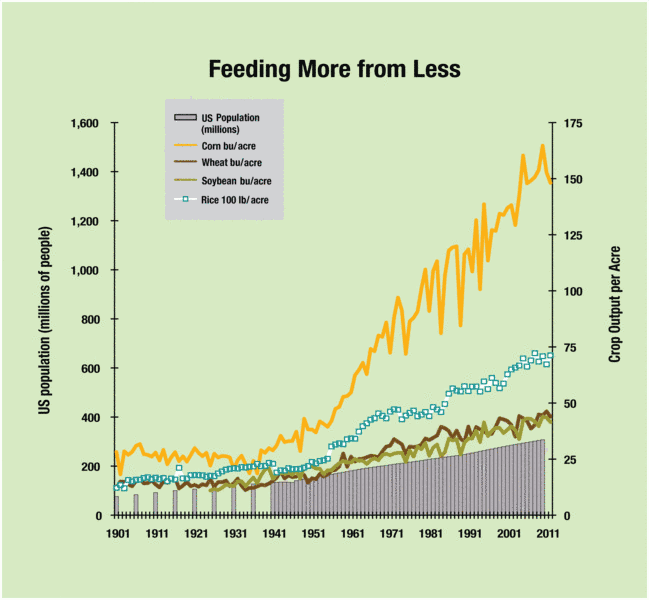
Halloween marked a new population milestone with the birth of the seven billionth person — an idea that is scary for some but sanguine for others. Worried about the finite resources available to a growing population, there is fear among some that we are headed toward famine and starvation in a world where population exceedsContinue reading “Feeding More From Less”
From Fields to Fish

In-stream flows have been “cussed and discussed” in Wyoming for 50 years, but it wasn’t until 25 years ago that a reluctant Wyoming Legislature enacted an in-stream flow law. And it wasn’t until last week that a Wyoming rancher actually offered his irrigation water right to the state to become an in-stream flow right to support fish. ToContinue reading “From Fields to Fish”
The Principle of Non-Regression: Environmental Laws That Can’t Be Repealed
Jim Huffman, a long-time friend of PERC, recently published an op-ed in the European edition of the WSJ entitled, “The EU’s ‘Non-Regression’ Gambit.” In it he says, On Sept. 29, European parliamentarians adopted a resolution calling for next June’s United Nations Conference on Sustainable Development in Rio de Janeiro to demand that all nations adhereContinue reading “The Principle of Non-Regression: Environmental Laws That Can’t Be Repealed”
Economic Prosperity for North American Indians
The link between natural resources, institutions, and economic prosperity is nowhere more apparent than on American Indian reservations. For this reason, PERC hosted a workshop at Lewis and Clark College on “Institutions, Resource Use, and Economic Prosperity for North American Indians.” If the scholarly papers presented at the workshop didn’t provide enough evidence of thisContinue reading “Economic Prosperity for North American Indians”
Economic Prosperity for North American Indians
The link between natural resources, institutions, and economic prosperity is nowhere more apparent than on American Indian reservations
Justice Stevens Defends Kelo
The WSJ’s Jess Bravin reports on an interview with recently retired Justice John Paul Stevens in which he defended his “most unpopular opinion” — Kelo v. New London — from recent criticism by Justice Antonin Scalia (see here and here). “It’s the most unpopular opinion I ever wrote, no doubt about it,” Justice Stevens said in an interview. He said he empathized withContinue reading “Justice Stevens Defends Kelo”