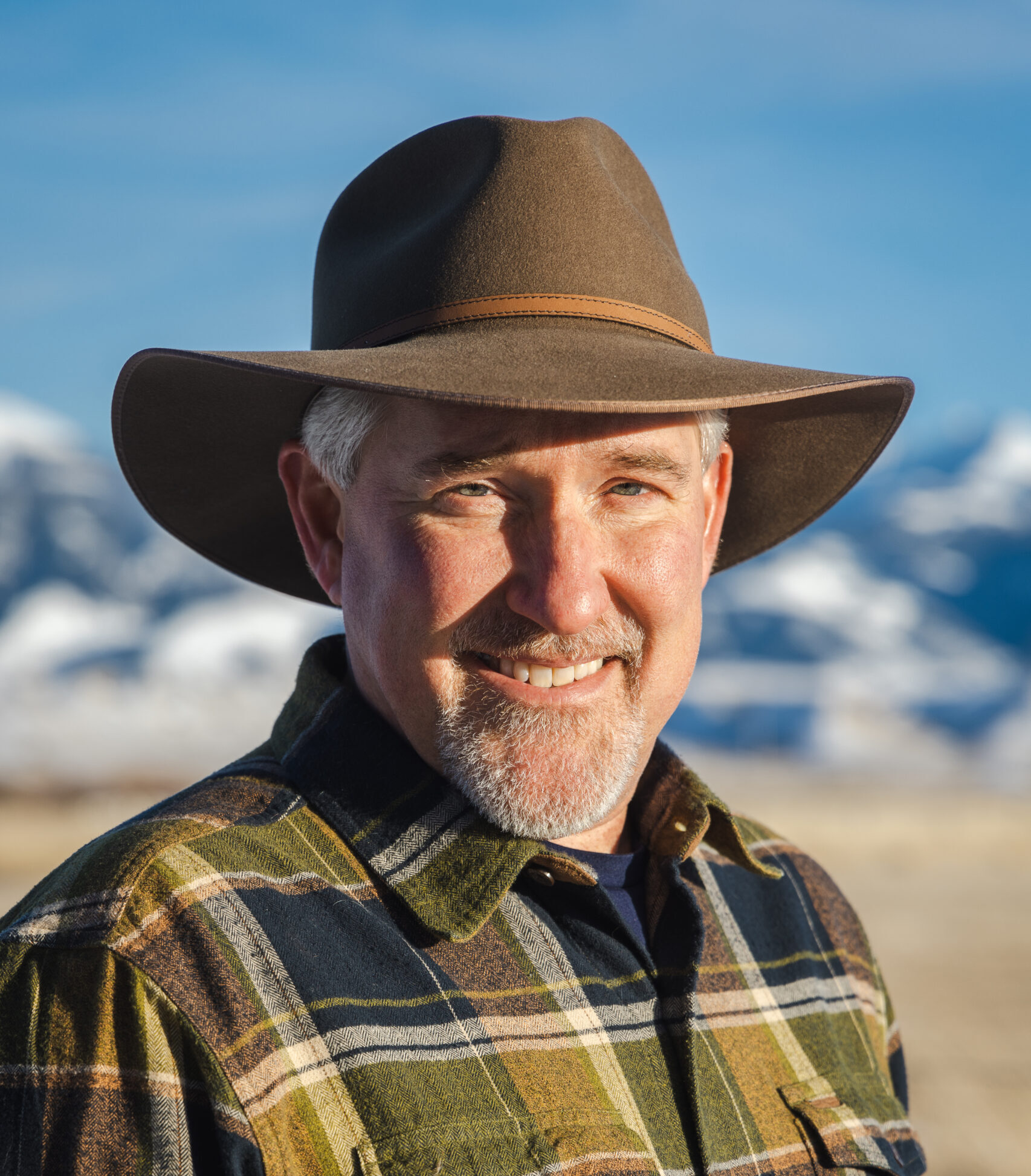
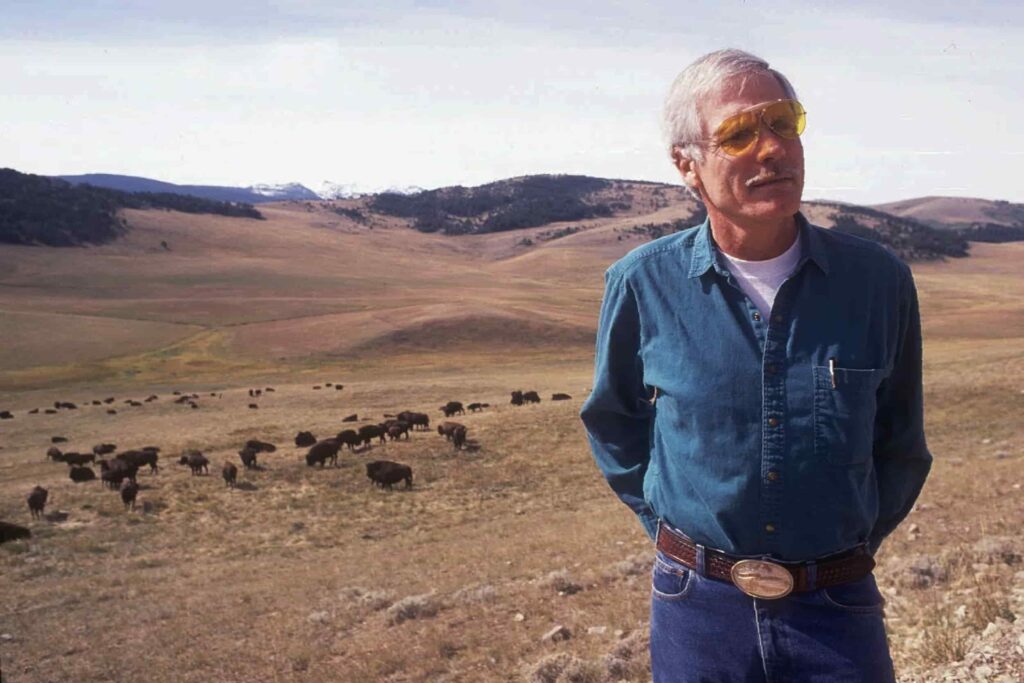
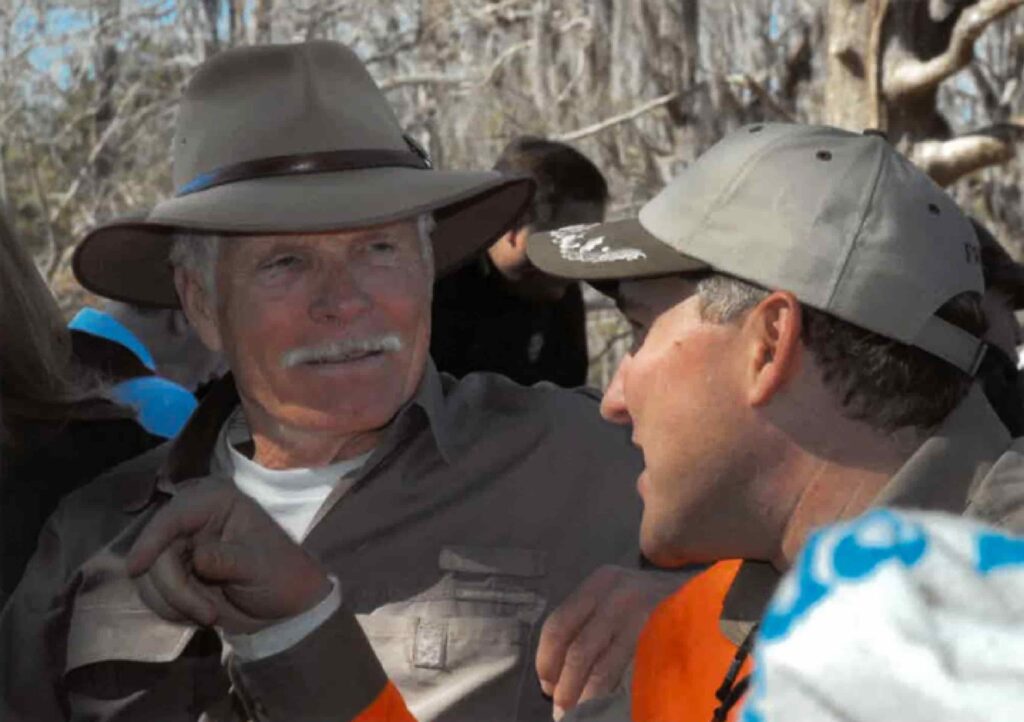
The last time I saw Ted Turner, he was seated at the front of a small vessel on Yellowstone Lake, surrounded by family on one of the Turner clan’s summer pilgrimages to their most treasured corners of the world. He was battling a disease that had taken his voice, but not his presence. I was there as a family friend, conservation partner, and featured speaker at that evening’s family dinner. As we boarded for a tour of the lake that morning, Ted stopped me, took my hand, and gave it a firm squeeze of recognition. No words were needed. It was the gesture of a man who had spent a life communicating through action more than language anyway.
Ted Turner passed away earlier this year. When the history of American conservation is written, there needs to be a chapter dedicated to him—and not primarily for the reasons you might expect. Yes, he almost single-handedly reintroduced the bison at scale to the American West, and his Ted’s Montana Grill restaurants brought bison meat to millions of dinner tables. But Ted’s most lasting conservation legacy is something larger. He invented “conservation ranching.” Ted proved, through nearly two million acres of his own land and his own capital, that private wealth deployed with ecological intention could restore landscapes at the scale of national parks, on a timeline measured in years rather than decades. The Flying D in Montana. Vermejo in New Mexico. Avalon in North Florida. Many others. Some of the best of the last best places, stewarded not by an agency but by a conservationist with a checkbook and a vision. Today, it is replicated by dozens of other successful entrepreneurs and businessmen conserving tens of millions of acres across the United States. But there will only be one first, and that is Ted Turner.
It is a quintessentially American story. And as we mark 250 years of this republic, it is worth recognizing that it is also a very old one.
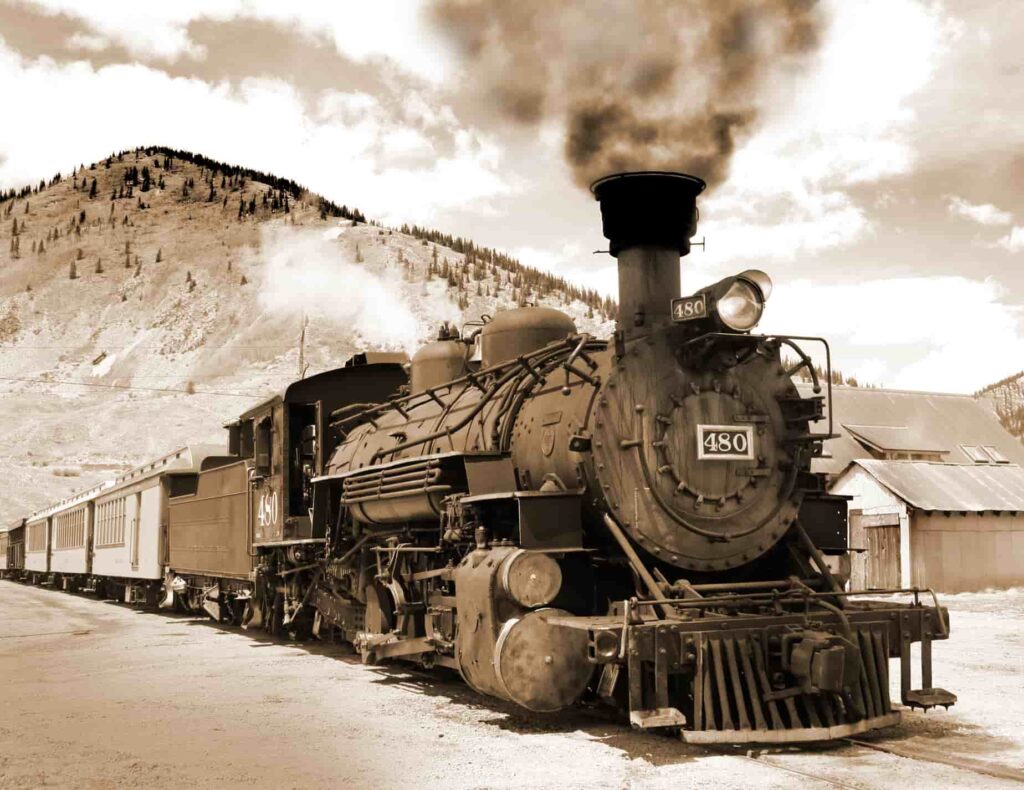
The national parks, widely celebrated as “America’s best idea,” were in fact born of a business deal. In 1871, Jay Cooke—owner of the Northern Pacific Railway—sponsored the addition of a painter named Thomas Moran to the Hayden Expedition into Yellowstone. Cooke paid Moran’s way because he understood that stunning images of the West would fill seats on his trains and secure the votes in Congress needed to create something new and special: the world’s first national park. As the expedition concluded, it was Cooke’s lobbyist who wrote to expedition leader Ferdinand Hayden suggesting that Congress “pass a bill reserving the Great Geyser Basin as a public park forever”—and asked him to include the idea in his official report. Hayden obliged. Congress established Yellowstone in 1872. Preservationists wanted it; the railroad made it happen. Without the quiet commercial maneuvering of a railroad magnate, the park idea might never have blossomed. And blossom it did.
Partnerships between preservationists and the railroads led to the creation of Yosemite, Grand Canyon, and Glacier National Parks, to name a few. None other than the “father of Yosemite National Park,” John Muir, concluded: “Even the soulless Southern Pacific R.R. Co., never counted on for anything good, helped nobly in pushing the bill for this park through Congress.” Other railroads like the Santa Fe, Great Northern, and Union Pacific got in on the act, developing grand hotels in the western parks and urging the nation to “See America First.” It was capitalism in service of conservation, stitched into the founding document of the entire national parks movement.
Fifty years later, a different kind of wealth shaped the parks again. John D. Rockefeller Jr., heir to the Standard Oil fortune, began quietly purchasing land in the Jackson Hole valley of Wyoming beginning in the 1920s through a shell company called the Snake River Land Company. He did this with the encouragement of Yellowstone Superintendent Horace Albright, concealing his identity to prevent land prices from spiking. Over the following decades, Rockefeller transferred tens of thousands of acres to the federal government, land that became the beating heart of Grand Teton National Park. He made similar gifts to help establish Acadia, Great Smoky Mountains, and Shenandoah. The parks we treasure today were not only set aside by acts of Congress—they were partly assembled, acre by acre, by private capital wielded with patience and purpose.
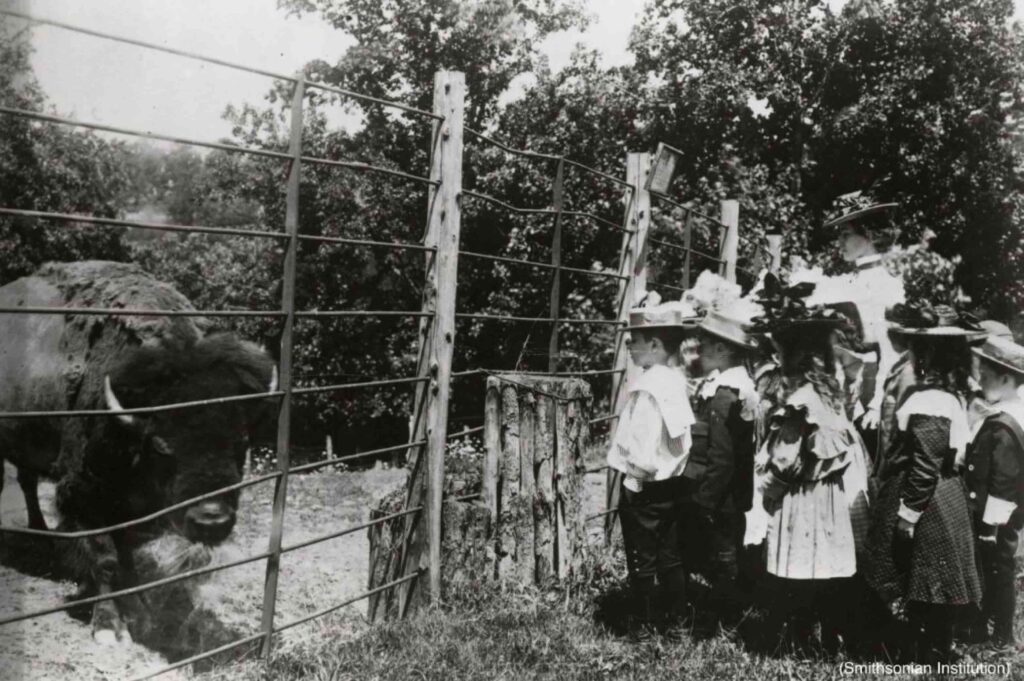
Not all of conservation’s capitalist partners have been billionaires. Some worked for widely recognized conservation organizations we know today: the Smithsonian and the National Zoo. At the time of their founding, both institutions recognized that surplus animal specimens, collected by government expeditions, boundary surveys, the military, and private individuals wanting to contribute to science, could be used as a de facto “currency” to help secure specimens from abroad. As historian Diane Smith wrote, the Smithsonian understood “that many of these duplicate specimens had an inherent value that could be exploited to the institution’s advantage.” Similarly, in 1890, the founders of the National Zoo requested that the interior secretary task Yellowstone National Park with sending 20 specimens of every animal available in the park. The zoo proposed using these live animals as “cash equivalents to obtain more specimens for public display.” While likely intolerable today, back then, the capitalistic use of wildlife built these great institutions.
Other effective conservation groups have their origins in the world of private enterprise and individual initiative too. The nation’s first wildlife conservation organization, the Boone and Crockett Club, was founded in 1887 by Theodore Roosevelt, George Bird Grinnell and a handful of wealthy hunters. As Douglas Brinkley described in The Wilderness Warrior, “most of the founders were New York capitalists with deep pockets,” though “none were afraid to get mud on his boots.” At its inception, the club, capped at 100 members, used its business prestige and influence to lobby for passage of the Forest Reserve Act of 1891 (the predecessor to the National Forest System) and the Yellowstone Protection Act of 1894 (to protect wildlife in the park) as well as the creation of the Bronx Zoo. Today, it continues to be an effective voice for wildlife and habitat protection.
Similarly, in 1937, at the depths of the Dust Bowl, when North American waterfowl populations had plunged to historic lows, a small group of duck hunting philanthropists pooled their resources and founded an organization called Ducks Unlimited. Their mission was simple: habitat conservation. The method was equally simple: raise private money, work with private landowners, and put wetlands back on the landscape. Nearly 90 years later, DU has conserved more than 15 million acres of wetland habitat across North America. Their work demonstrates what organized private conservation can accomplish when it meets landowners where they are, with incentives rather than mandates. Waterfowl populations have risen 56 percent since 1970, even as other bird populations have collapsed. Duck hunters did that.
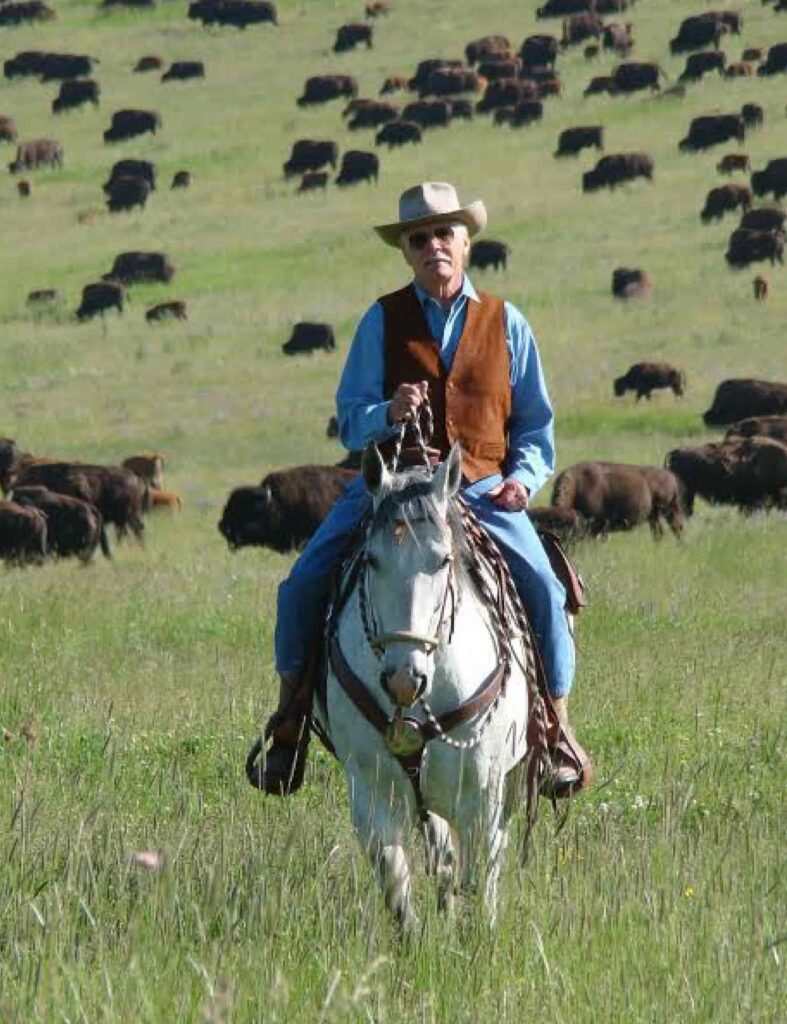
And then there is the national mammal of the United States—the bison—the animal that, more than any other, embodies both the failure and the redemption of American conservation. Tens of millions reduced to fewer than a thousand by the late 1880s. The comeback is an incredible wildlife recovery story, and it happened first and foremost in private hands—by owners, including former buffalo hunters, who, for reasons commercial and otherwise, chose to invest in an animal that had nearly been exterminated. Today, roughly 90 percent of the nation’s bison live in private commercial and entrepreneurial herds. Ted Turner was the most visible of these stewards, but he was one expression of a much broader private ethic. The bison’s recovery was not legislated into existence. It was ranched into existence.
The standard telling of American conservation history runs like this: Theodore Roosevelt draws lines on maps, Congress passes laws, and the natural world is saved. That story is true, and it is important. But it is incomplete. Running alongside—and often preceding—the government narrative, at every turn, is another story. It includes railroads and oil heirs and hunters and ranchers who put their own capital behind their conservation convictions. Sometimes they did it for profit, sometimes for passion, and often for both, as Ted Turner did. History can be messy. More so when the uncomfortable relationship between capitalism and conservation does not fit the conventional narrative.
Like it or not, capitalism, manifested in many different shapes and sizes, has been the quiet but effective ally of conservation throughout. The American genius for conservation has always been this: harness the power of private incentives alongside public protection. People protect what they value. When they have a stake in the outcome, conservation endures.
As America turns 250, that insight is not a historical curiosity. It is a blueprint. The next great gains in conservation will not come from drawing more lines on more maps. They will come from the same place the first ones did—from individuals, entrepreneurs, and organizations who see in the natural world not a problem to be regulated but an investment worth making. At PERC, it is the work we are proud to carry forward. And if Ted Turner taught us anything, it is that one person with a clear vision and the will to act can move the needle further than a generation of good intentions.