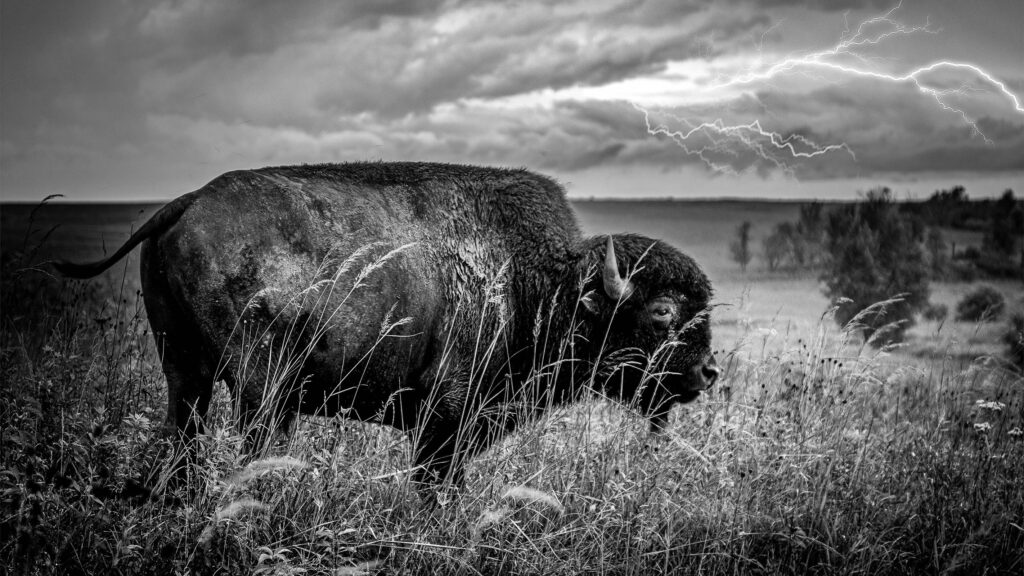
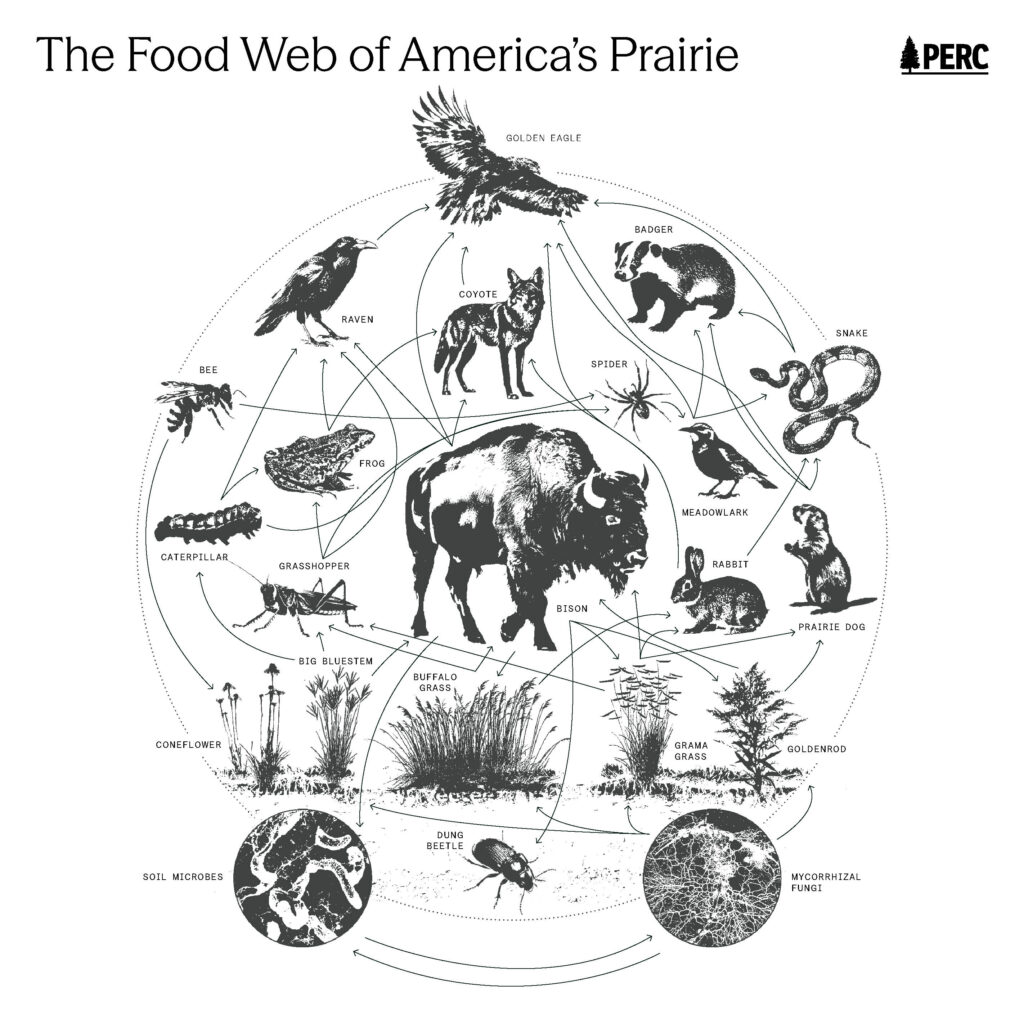
Ask a first grader to draw a bison, and they’ll probably sketch you a brown beast with shaggy shoulders, a stylish goatee, and horns —pretty much a weird, hairy cow. Ask a historian, and they might draw a vast, rolling herd, perhaps being hunted by Native Americans, settlers, hide traders, or the U.S. Army. But ask an ecologist to draw you a bison, and you’ll get a more complicated picture. It includes a whole lot of other creatures, so many that the bison looks like an afterthought, a tiny brown meatball at the center of a sprawling spaghetti diagram. But the small scale reflects their outsized ecological importance, achieved through relationships with many other organisms.
The bison emerges as a central node in an intricate web moving nutrients and energy around the community of living things within the ecosystem. Bison connect to grasses and forbs by feeding on them. But they also link to things far beyond: to soil microbial communities, prairie dogs and badgers, deer and elk, pronghorn and cattle, coyotes and wolves, and many more, through processes including competition, nutrient deposition, soil disturbance, and, eventually, provision of their carcasses as food.
A bison’s ecology is defined by its relationships to other living things, yet most bison today are privately owned and constrained by fences, rather than free-roaming. Some of the relational threads that once connected bison to their ecosystems, and to people, are either broken or missing. Yet even a frayed web has value. And where bison threads remain, they still bind.
From the Ground Up
From their teeth to their guts, grazing animals like bison are specialized to eat grass, as well as forbs and other plants. But just as surely, grass has adapted over eons to be grazed. Buffalo grass (Bouteloua dactyloides), a warm-season, fast-growing species, has evolved to be extremely resilient to herbivores eating it, as well as to drought. One of its primary adaptations is being able to regrow and spread via underground runners, called stolons, which over time produce a thick, tough mat of roots, matched by a large patch of soft, gray-green foliage aboveground that can quickly resprout from the base even after heavy grazing.
Rapid regrowth is a good trait to have, because a herd of bison can cause considerable damage to grass. They crop its blades short, and they trample it with all of the pressure brought to bear by 2,000 pounds concentrated onto four sets of hooves, multiplied across an entire herd. Bison diets are roughly 80 percent grass in the shortgrass prairie, mostly because that’s the dominant vegetation. But the grass gets something in return. As these shaggy eating machines move across the prairie, not only are they grazing, they are also disturbing the soil by wallowing and raining down nutrients in their feces and urine. The bison thunderstorm rolls in, tramples, crops, wallows, and fertilizes, then leaves a churned and fecund zone of opportunity in its wake. Where dominant grasses are heavily grazed by bison or cattle, or burned by wildfire for that matter, other prairie plants can better compete. Where wallows create bare dirt, rare plant species that specialize in newly disturbed habitats can colonize. Outside of the wallows, the buffalo grass resprouts from its stolons, supercharged by the gift of nutrients.
Buffalo grass and other prairie plants are well-adapted to these bison thunderstorms thanks to a long history with heavy herbivory. Bison are the last of a mega-herbivore menagerie that once roamed the Great Plains. Most died out following the last ice age, including mastodons, North American camels, and other massive grass-eaters. But unlike most of the other mega-herbivores, bison abundance increased greatly in the warming climate conditions following the ice age. During the same period, dominant prairie vegetation shifted from cool-season to warm-season grasses, which are highly resilient to intense herbivory. By the time Europeans arrived, bison were distributed in a wide, vertical “bison belt” that extended from Alaska all the way south to Mexico and covered almost 60 percent of the continent, spreading from the Rocky Mountains eastward to the Atlantic.
Diminished Yet Consequential
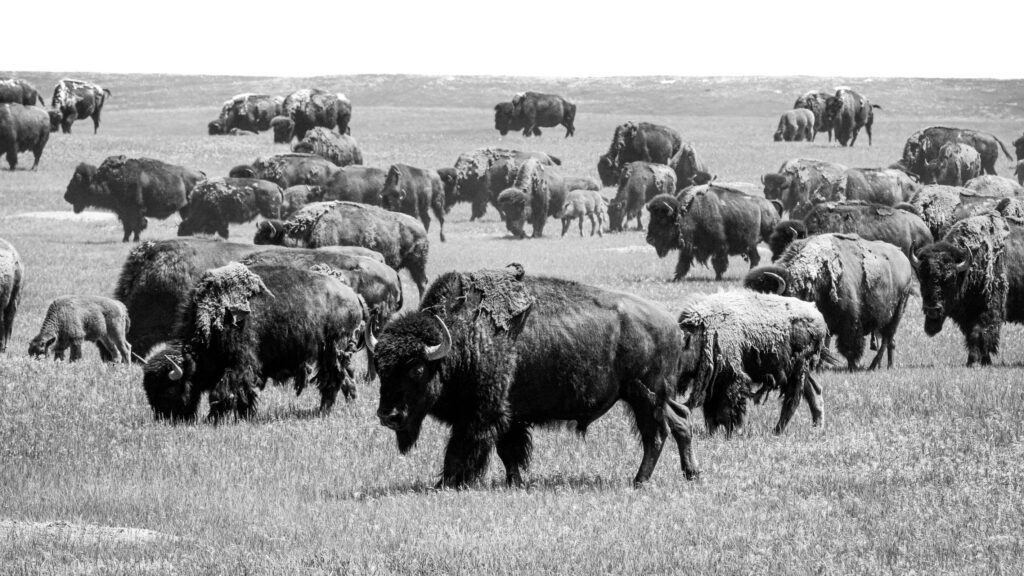
The rise of ecological research trailed the massacre and decline of free-roaming bison. We are left trying to piece together a picture of how bison interacted with their past grassland and prairie ecosystems by studying much smaller and more sedentary modern herds. Most shortgrass and tallgrass prairie that were once bison strongholds have been converted to agriculture. And most remaining prairie will never feel a bison’s hoof and are instead managed with cattle grazing, sometimes with the addition of prescribed fire. But today’s diminished herds reveal that bison can impact entire ecosystems, if they are given sufficient time and space to throw their weight around.
The vast majority of plains bison roaming North America today are privately owned, held by commercial ranching operations, tribal governments, or conservation groups. Unlike domestic cattle, most are pastured on rangeland year-round, although they are constrained by physical fences, unlike their wild forebears. Across studies, bison exhibit more movement, less time grazing, and less time spent near water than cattle. Similarly, bison select foraging patches at much larger scales than cattle, even in private herds. For example, research led by the University of Montana found that bison grazed patches of 20,000 to 30,000 acres at a time at American Prairie (a private conservation herd in Montana) and Grasslands National Park (a public herd in Saskatchewan), an area larger than most private ranches in the western U.S. For comparison, cows in the same study used patches of only 120 to 1,000 acres, despite similar stocking densities. Modern bison herds average fewer than 200 animals—far too small to support the full breadth of bison ecological processes, unless herds and acreage grow dramatically.
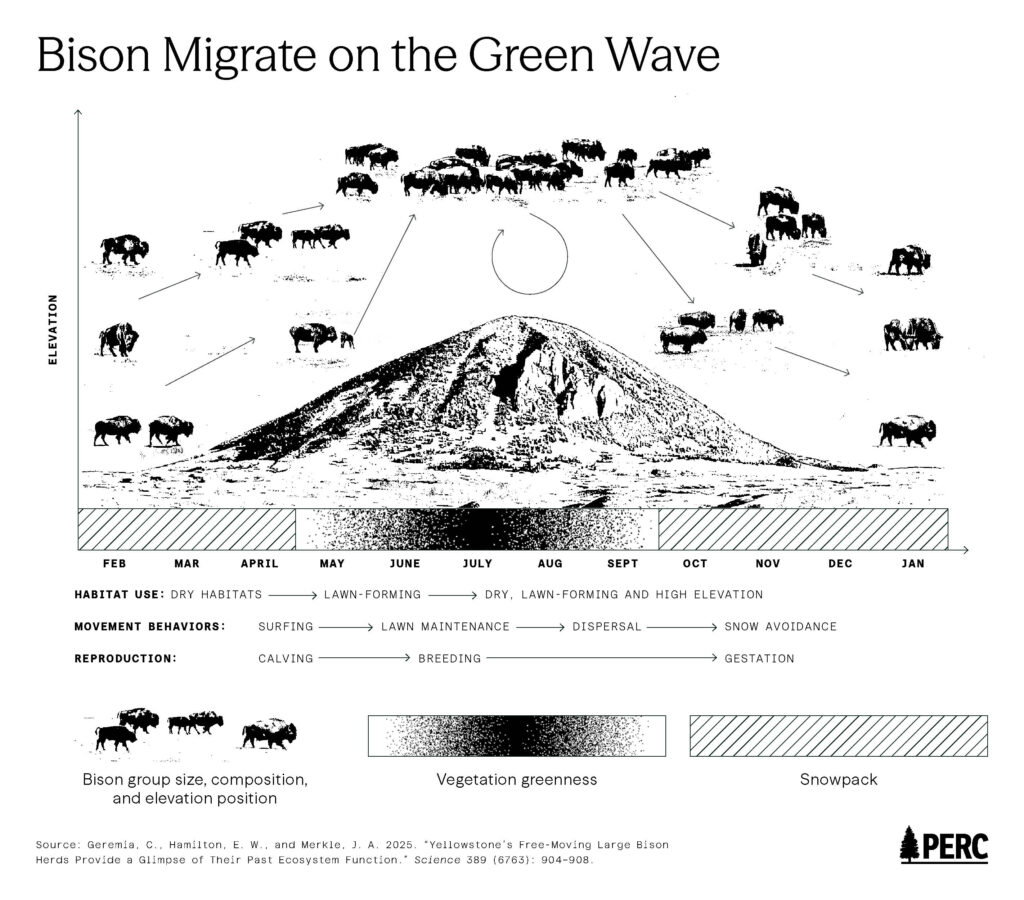
Bison migration is another factor constrained for today’s private and public herds alike. Long-distance movement is one of the species’ defining behavioral and ecological differences from cattle, and they would travel much farther if untrammeled. For example, the Yellowstone bison are the only migratory herd in the lower 48 states. From just a couple dozen tenuous survivors of the 1800s slaughter, the herd has grown to thousands strong. Yellowstone bison now migrate from low-elevation winter range to higher summer areas, increasing grass growth and protein content along their route by grazing and fertilizing. Yet even this herd, which appears quintessentially wild, is controlled in numbers, behavior, and ecology. The herd size is capped by human culling, and private land near the park constrains winter range, although conservation agreements have increased the amount of available habitat, and transfer programs to tribes decrease herd density. Some ecological evidence suggests that the herd is too numerous, exceeding historic densities and resulting in deterioration of riparian condition within the park.
Yet despite restrictions on herd size, range, and movement, today’s bison still perform many other behaviors distinct from cattle that yield ecological benefits. They still graze, horn, and wallow as their instincts dictate. They move rapidly and widely within the limits of their pasture boundaries, reducing grazing pressure on any one patch of prairie and boosting many kinds of grassland biodiversity, from birds to beetles. Bison-grazed prairies also show increased resilience to drought, an increasingly relevant metric for conservation and livestock production alike in our changing world. All of these documented ecological functions of bison in private and public herds are manifesting despite higher stocking densities than would likely have occurred under wild, unrestricted conditions in the past.
Perhaps all bison exist somewhere along a continuum of ecological function. The wider bison can roam, the more of their ecological functions they can fulfill. Many conservationists say that bison are ecologically extinct because they can no longer graze across the enormous scales they once did. Yet for some private herds, their size and movements may be approaching many if not most “bison functions.” For example, Turner Enterprises grazes 45,000 bison or so across a dozen massive U.S. ranches, while The Nature Conservancy owns approximately 6,600 bison across 11 different locations. These herds are managed to benefit ecosystems and biodiversity. And while these private rangelands, and the pasture management units within them, are likely still not large enough to allow bison to fully manifest their ecological functions, there are undoubtedly major components of ecological “bisoning” that are occurring at scale for large private herds such as these, and on smaller operations to lesser degrees.
Broadening the Bison Belt
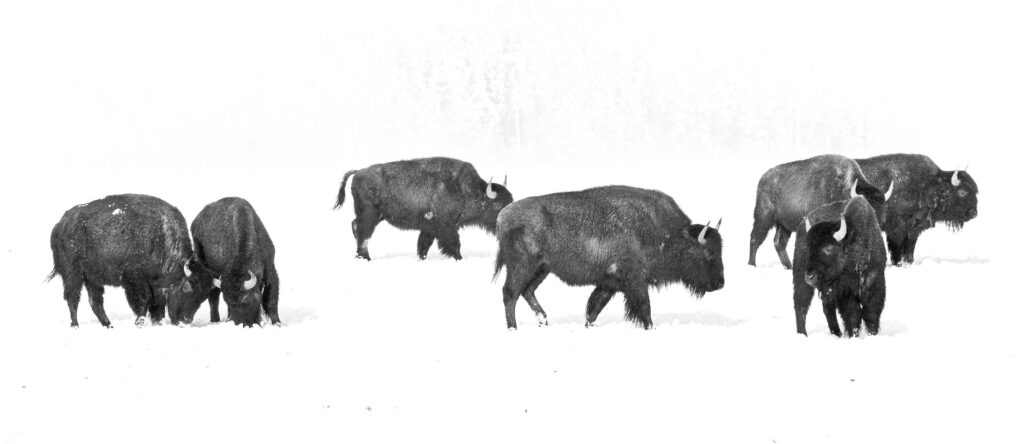
What is the potential future for bison, numerically and ecologically? After all, the plains bison’s scientific name—Bison bison bison—conjures up abundance as its primary characteristic. Of the American bison alive today, perhaps 25,000 are in tribal herds, with another 30,000 in public or private conservation herds. Most, however, are in for-profit herds, which have leveled off at fewer than 200,000 over recent years. Eighty-two percent are in the western U.S., in herds of 200 on average. In the East, commercial herds usually number fewer than 50. And while most managers of private herds report managing for ecological values, these herd sizes of dozens to hundreds are unlikely to achieve massive ecological benefits.
Even the smallest herd serves a function that ecological accounting rarely captures: connecting people to land. Simply encountering wildlife in a captive zoo setting can spark a connection with nature for people that manifests in a greater commitment to conservation action. Likewise, seeing a bison herd even behind fences can be a memorable experience, for children and adults alike—a reminder of their wild and free ancestors—and can help people develop lasting attachments to particular landscapes, and a stake in conserving them.
Tribal herds hold great promise for scaling bison ecologically while restoring relationships with people. Beginning in the 1990s, Native American and First Nations governments in the U.S. and Canada organized and collaborated to restore bison, primarily on indigenously managed land. These tribal herds have grown to more than 30,000 animals across all of North America, and are still expanding, unlike the stagnant aggregate numbers of commercially managed bison. This growth is the result of cultural, spiritual, nutritional, and economic benefits that bison bring to tribal communities. Given the huge acreage managed by tribes and their members, there is much more restoration potential.
In the future, increasing drought and shifting beef markets could make bison more competitive with or complementary to cattle production. Bison are hardier than cattle and, with enough pasture, capable of self-sufficiency year-round. They also eat lower-quality forage, and graze farther from water, making fuller use of arid land than cattle. And bison grazing itself can bolster drought resilience in the prairie plant community, another potential economic upside for bison.
As long as there is growing demand for bison meat, there are market incentives for the private herds to continue to grow in size. And growth in numbers may lead to more opportunities to manage bison so that their ecological function grows more capacious. After all, they can be so much more than big, hairy brown cows. Bison thunderstorms, or at least buffalo showers, could once again move across landscapes. The shortgrass prairie, at least, wouldn’t care whether they were wild or not.