Legislation championed by Sen. Daines and Sen. King advances without opposition; bill draws directly on PERC research to tackle the park maintenance backlog
BOZEMAN, Mont.—The America the Beautiful Act passed out of the Senate Energy and Natural Resources Committee this morning without a single vote in opposition, marking a major step forward for legislation to maintain our national parks and public lands that the Property and Environment Research Center (PERC) has worked for years to help shape and advance.
PERC extends its sincere thanks to Senator Steve Daines (R-Mont.) and Senator Angus King (I-Maine) for their leadership in championing this bipartisan bill, as well as to the more than 60 cosponsors who have backed the legislation in the Senate.
“National parks are where patriotism meets place,” said PERC CEO Brian Yablonski. “They remind us that loving America means caring for the landscapes that tell our shared story. That’s why the bipartisan support for the America the Beautiful Act matters. It proves some treasured landscapes are bigger than politics.”
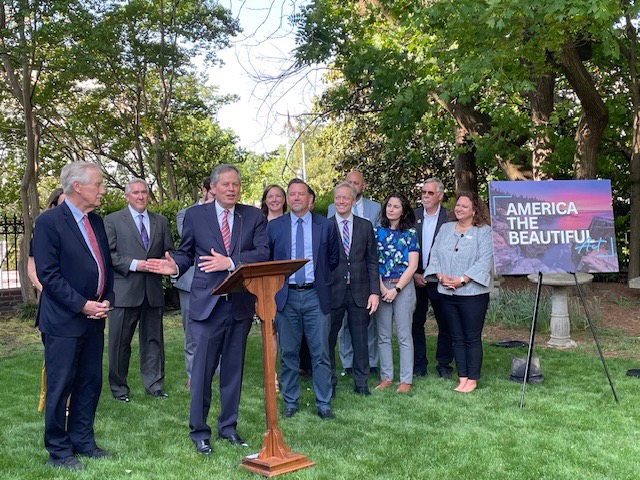
PERC has worked closely with Senate leadership to advance the effort, with CEO Brian Yablonski standing alongside Sens. Daines and King when the bill was first introduced last year. Crucially, the American the Beautiful Act recognizes the opportunity to generate needed maintenance funds through an international visitor surcharge—a PERC-driven policy the National Park Service adopted last year.
This Senate committee vote builds on broader momentum to reauthorize an innovative funding stream to maintain our national parks and public lands. Last week, the House Natural Resources Committee also held a field hearing on their version of the proposal, the Great American Outdoors Act 250 championed by Congressman Bruce Westerman (R-Ark.) and Congressman Jared Huffman (D-Calif.). PERC looks forward to continuing to work with both chambers to maintain our public lands.
What the America the Beautiful Act does
The America the Beautiful Act will help pay for the immense amount of maintenance needs across our national parks and public lands. Rather than being dependent on a fickle congressional appropriations process, this approach harnesses international visitor fee revenue, private donations, and other user-generated funding to provide $9.5 billion for failing wastewater systems, crumbling bridges, trails and campgrounds, deteriorating roads, and other maintenance needs.
This legislation includes multiple reforms PERC has long pushed for:
- Reauthorizes and strengthens the National Parks and Public Land Legacy Restoration Fund for five years, focusing on caring for the lands we already have.
- Protects international visitor fee revenue so that the money generated by overseas visitors stays dedicated to public land improvements rather than disappearing into the general budget.
- Requires agencies to prioritize projects based on visitation levels and safety risk, directing limited dollars to the places where they will do the most good.
- Directs the streamlining of the permitting process to help needed maintenance projects be completed quickly.
- Maintains an innovative endowment-like fund to generate future returns and cover administrative costs.
PERC research that helped build the bill
The America the Beautiful Act draws directly on a body of PERC research aimed at fixing how the federal government funds and manages national park maintenance. Key reports that informed the bill’s provisions include:
- A Path Forward for America’s Best Idea, which celebrated parts of the Great American Outdoors Act worth continuing and diagnosed the flaws in the Park Service’s deferred maintenance system and proposed reforms to restore confidence in how maintenance dollars are tracked and spent.
- How Overseas Visitors Can Help Steward Our National Parks, the 2023 policy brief that first proposed an international visitor surcharge—an idea now central to how the bill protects and directs new park revenue.
- 10 Ideas for the Interior Department, which called for doubling fee revenue with international visitor fees and using smarter pricing tools, rather than relying on appropriations, to fund park stewardship.
- The Economics of Awe, an economic analysis showing that targeted entry fee increases, especially with international visitors, at parks like Yellowstone could generate two to five times current revenue with minimal impact on visitation.
- PERC Reports: Under Pressure, a special magazine issue examining how booming visitation is straining park infrastructure and what modern funding models could relieve that pressure.
About PERC: The Property and Environment Research Center (PERC) is the national leader in market solutions for conservation, with over 40 years of research and a network of respected scholars and practitioners. Through research, law and policy, and innovative applied conservation programs, PERC explores how aligning incentives for environmental stewardship produces sustainable outcomes for land, water, and wildlife. Founded in 1980, PERC is nonprofit, nonpartisan, and proudly based in Bozeman, Montana.
# # #