
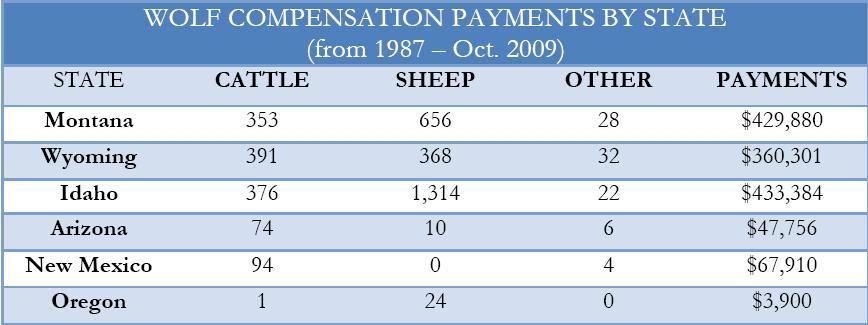
by Shawn Regan For over two decades, Defenders of Wildlife has paid out more than $1.4 million to livestock owners that have had livestock killed by wolves. With wolf numbers on the rise, Defenders recently announced they were ending their compensation program, but it appears–at least for the Mexican gray wolf in Arizona and NewContinue reading “Wolf Compensation Continues in the Southwest”
Author Archives: admin
Wolves, Mosques, and Other Environmental Problems
Most environmental issues involve resource conflicts. One person wants to use a river to carry away her waste products, while another one wants to swim and fish in the same stream. Often these uses conflict and collide. A modern example of how “enviropreneurs,” or environmental entrepreneurs, come to see these conflicts involves wolf restoration toContinue reading “Wolves, Mosques, and Other Environmental Problems”
Terry Anderson on C-SPAN
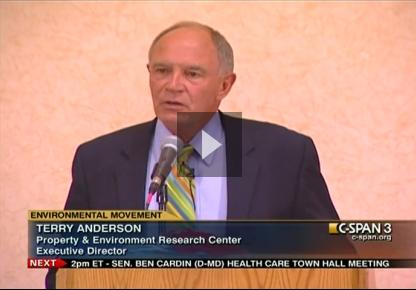
by Laura Huggins Don’t miss PERC’s Executive Director, Terry Anderson, discussing free market environmentalism on C-SPAN. He models some funny hats too!
Big Meat: A Reaction to the Livestock Convention
by Paul Schwennesen
I squandered a beautiful Colorado morning in CSU’s ballroom yesterday. Around 2,000 of us were there to provide first-hand testimony to Attorney General Holder and USDA Secretary Vilsack about the growing concerns over consolidation in the meat-packing industry.
While most of us were wearing hats, I noticed an awful lot of them were in hands, not on heads. Appealing for help to the ‘Suits on the Podium,’ about a third of the audience was unashamedly suggesting that the Government come in and rescue the small family rancher.
Look, I’m as concerned about the demise of a way of life as the next man. I’m as disgusted with the decrease in cattle prices as anyone else. I too wish ranchers could make the same returns as thirty years ago. I don’t like that 80% of the meat-packing industry is in the hands of four conglomerates. But where I part ways with some of the crowd is in my view of the solutions to these issues.
Asking government to break the back of “Big Meat” is like asking your hangman to pull the next guy’s lever first.
There seems to be an increasingly prevalent view that “something is going on” in the cattle market, that “Big Meat” is brandishing unfair market leverage which screws the little guy. And don’t get me wrong: I’d be the first to rally if a Federal probe unearthed findings that Cargill, Tyson, National or JBS was engaged in price-fixing, collusion, or fraud. But I’m afraid that after 6 hours of public testimony, I got no inkling of such manipulations. What I got was an inkling that some of us would rather see higher prices for our cattle (no kidding?), that ranchers get a “fair shake” (whatever that means), and that the big guys open their books to their private transactions to let the rest of us see what’s going on. These might sound good, but will they really solve the problem?
Why Is Parking Free?
by Wally Thurman
Tyler Cowen has recently promoted the idea that parking in America is costly and inappropriately provided mostly for free. Summarizing a recent book by Donald Shoup, The High Cost of Free Parking, he argues that at zero price, Americans park their cars a lot and generate congestion and impose costs on others. Among the problems he cites: local zoning boards require stores to build a minimum number of parking spaces–more than they would choose absent coercion. Cowen argues that it would improve resource allocation if such requirements were eliminated, the end result being fewer parking spaces and, presumably, stores charging for their use.
Cowen’s observations are intriguing–they suggest that free market proponents should urge planning boards to free big-box retailers from the yoke of parking requirements. Let the market speak and it will say that parking–unlike information on the internet–does not want to be free.
While still digesting Cowen’s observations, I awoke today to a letter to the editor in my hometown Raleigh News & Observer, written by environmental resource conservation professor George Hess of North Carolina State University. In his off hours, Hess serves on the Land Use Review Board of Knightdale North Carolina. He writes that his board does, indeed, stipulate minimum numbers of parking spaces that a retail development should have. (It also stipulates maximums.) But, he observes, developers never propose to build parking lots of just the minimum size and often seek to build more parking spaces than the board’s maximum. At least in the case of Knightdale (near Lizard Lick, by the way), the government restriction that Cowen worries about is never binding.
If Hess’s experience is the norm–and I don’t know that it is or isn’t–then I see no market-based opposition to free parking. It may be unsound to have a retail society based on free parking. But it is unlikely due to government regulation.
Suppose that Hess’s experience generalizes: that free parking at retail stores is not the result of government regulation. We’re left with the question of why stores provide free parking when they do (they don’t in Manhattan.) I see two possible answers.
Talking Green in Yellowstone
by Laura Huggins Following on the heels of Joe Biden’s recent visit to Yellowstone touting green jobs, PERC senior fellow Roger Meiners exposes the folly in much of the “green” stimulus spending in today’s Wall Street Journal. Not far down the road from Bozeman is the village of Ennis, home to the U.S. Fish and WildlifeContinue reading “Talking Green in Yellowstone”
Talking Green in Yellowstone
Stimulus spending for green jobs is short sighted. The solar panels produced can make electricty for less, but will eventually cost more to replace.
Free Market Environmentalism and Climate Change
by H. Spencer Banzhaf This year is PERC’s 30th anniversary, and looking back it has many intellectual successes to celebrate, as it has met the challenge of showing how free-market solutions can solve many environmental problems. Looking forward, it will surely have many more successes as it continues to wrestle with new challenges. One ofContinue reading “Free Market Environmentalism and Climate Change”
Crosses, Stars, Moons, and Green Street-Side Bins

What do these four symbols have in common? Well, to start with they all cost resources, that is, they are not free. Why in the heck then do practitioners waste their money on them? Why do churches have steeples, and synagogues wonderfully ornate glass windows, and mosques, exquisite wool carpets? Surely the money spent onContinue reading “Crosses, Stars, Moons, and Green Street-Side Bins”
Paul Schwennesen honored in global essay contest
Paul Schwennesen an Enviropreneur-in-Residence at PERC and a former fellow at the Enviropreneur Institute is one of seven top winners in a global easy contest sponsored by the SEVEN Fund in Cambridge, MA.
The topic was the “morality of profit.”