
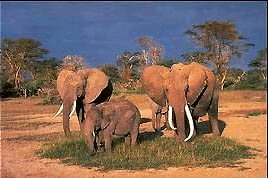
When people who live near wild elephants understand how they can benefit economically, they have an incentive to protect the wildlife.
Types Archives
Do federal land programs crowd out private land conservation?

PERC scholars compare the Conservation and Wetland Reserves, both federal programs, with two private land trusts,The Nature Conservancy and the Land Trust Alliance,to determine their influence on each other.
Liberia is saving its rainforests with barcoding

The West African nation of Liberia has partnered with the European Union in a unique attempt to protect its remaining forests by barcoding every harvestable tree.
Fair-trade coffee producers often end up poorer
By Lawrence Solomon Coffee is one of our guilty pleasures, and not only because of the calories that can be packed into a double latte. Many of us feel guilty that our pleasure is coming at the expense of the Third World coffee farmer, so much so that we gladly pay more for “fair-trade”Continue reading “Fair-trade coffee producers often end up poorer”
Rural areas most vulnerable to climate change
By Matthew Kahn In Climatopolis, I argue that urban growth will help us to adapt to climate change. Cities make us richer (due to trade, learning and specialization) and income will help people to adapt to the challenge of climate change. Productivity in cities takes place indoors and is more immune to climate conditions thanContinue reading “Rural areas most vulnerable to climate change”
Does the government perpetuate American Indian poverty?

Fox Business News correspondent John Stossel ignited a fire under many viewers when he accused American Indians of being government freeloaders. He returned to that issue in early May with a debate between PERC’s Terry Anderson and Indian activist Elizabeth Homer. Anderson is a noted expert on Indian economies. He points an accusing finger at the governmentContinue reading “Does the government perpetuate American Indian poverty?”
Politics of Endangered Species

Buried in the continuing resolution funding the federal government for the remainder of 2011 is a rider that delists the gray wolf as an endangered species in Montana and Idaho. The rider had bipartisan sponsorship from Sen. Jon Tester, Montana Democrat, and Rep. Michael K. Simpson, Idaho Republican, but the public reaction is anything butContinue reading “Politics of Endangered Species”
Beware the Siren Song of Green Political Activism
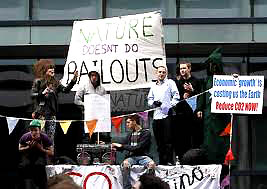
Green activism is often a threat to the very environment that activists are trying to save.
2011 PERC Fellows
Each summer, PERC awards fellowships to scholars, journalists, business people and environmentalists from around the world who are engaged with the same ideas and approaches to conservation as PERC. Their particular interests vary widely, including forestry, fisheries, ecosystem services, climate change, conservation easements, energy development as well as many other topics. Fellows are expected to spendContinue reading “2011 PERC Fellows”
Basic economics can preserve the environment

The industrial revolution that began about 200 years ago has changed humanity’s relation to, and attitudes about, nature completely—and sometimes it has generated new views about God and nature, such as from the Transcendentalists of the 19th century. In the first half of the 19th century, Alexis de Tocqueville reflected that in America, civilization endedContinue reading “Basic economics can preserve the environment”