

By Randy T. Simmons and Kimberly Frost Executive Summary About the Authors Introduction [[{“type”:”media”,”view_mode”:”media_original”,”fid”:”7202″,”attributes”:{“alt”:””,”title”:””,”class”:”media-image”,”typeof”:”foaf:Image”,”style”:”width:180px;height:119px;float:left;margin:0 1em 1em 0;”,”wysiwyg”:1}}]] Without accurate figures for the costs of the Endangered Species Act, the ongoing public debate over whether the law is effective will be a misinformed one. This study, Accounting for Species, contributes to the debate by analyzing theContinue reading “Accounting for Species:”
Author Archives: admin
Private Land Conservation
In the University of New Mexico School of Law’s Natural Resources Journal, PERC scholars examine the Valles Caldera Trust and other examples of voluntary stewardship.
Accounting for Species:
Executive Summary By Randy T. Simmons and Kimberly Frost Arational public dialogue about the value and effectiveness of the Endan- gered Species Act (ESA) must consider the costs incurred by the regulators and those being regulated. The U.S. Fish and Wildlife Service�??s report Three-Year Summary of Federal and State Endangered Species Expenditures, Fiscal Years 1998-2000Continue reading “Accounting for Species:”
Anthony Fisher Award Presented to Eco-nomics
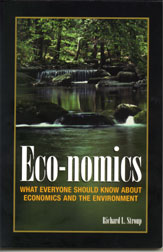
Eco-nomics What Everyone Should Know About Economics and the Environment Order the Book CHICAGO – April 28, 2004-The Atlas Economic Research Foundation presented its 2004 Sir Antony Fisher International Memorial Award to PERC, the Property and Environment Research Center, of Bozeman, Montana, today. The award was given for the book Eco-Nomics: What Everyone ShouldContinue reading “Anthony Fisher Award Presented to Eco-nomics”
Averting Water Disputes: A Southeastern Case Study
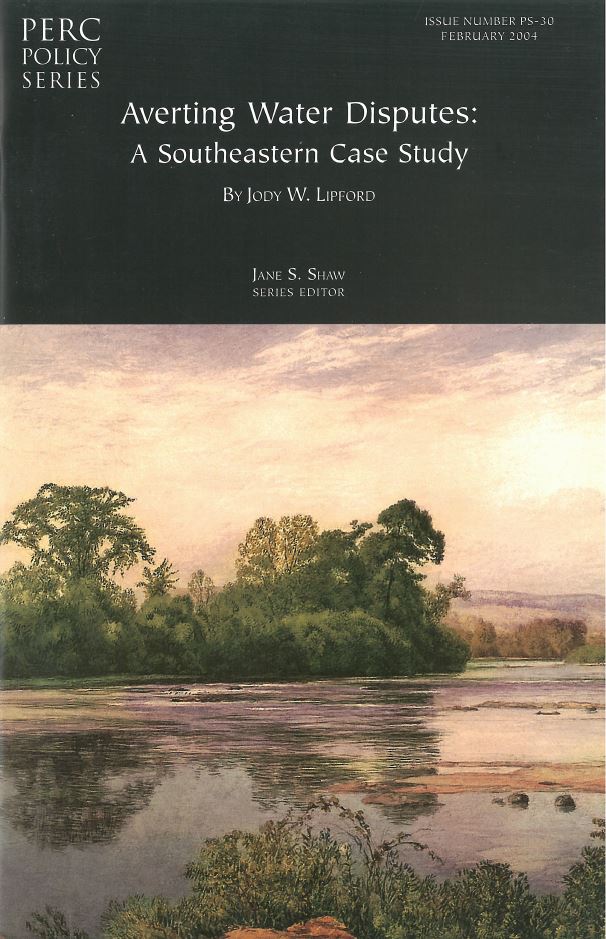
With abundant rainfall, the southeastern United States has rarely experienced conflicts over the allocation of water. But that is changing. As population grows, the demand for water grows, and when periodic drought occurs, disputes can result.
Incentives At Work

In Anchorage, Alaska, companies are giving their employees incentives to reduce winter air pollution. They come in the form of cold hard cash, and they work. But the companies too have an incentive to reduce air pollution. Green Star, a local nonprofit, hands out well publicized Air Quality Awards to the companies that make anContinue reading “Incentives At Work”
Revolutionizing Pulp

The rising global demand for paper is forcing producers to look beyond trees to crops such as flax and hemp. The increase in forests set aside for wildlife preserves and recreation is also reducing the availability of wood pulp typically used in papermaking. Experiments conducted by Alberta-Pacific Forests Industries Inc. (Al-Pac) of Canada indicate thatContinue reading “Revolutionizing Pulp”
Overcoming Hurdles to IFQs in U.S. Fisheries
By Donald R. Leal, Michael De Alessi, and Peter M. Emerson For decades, U.S. federal fisheries policy has relied solely on direct regulations to prevent overfishing. Such an approach has not eliminated overfishing, nor has it prevented the enormous waste and hazard of fishing under a destructive race for fish. The good news is thatContinue reading “Overcoming Hurdles to IFQs in U.S. Fisheries”
Facing The Unknown

The shadowy “precautionary principle” is stopping progress and distorting priorities.
Slamming the Door on Low-Income People?

Are entrance charges keeping low-income people from enjoying the outdoors?